Drowning in Credit Card Debt? What to Do When You Know You Cannot Keep Making the Payments
You may still be making every payment on time, but you already know the math no longer works. Your credit cards are nearly maxed out. Minimum payments keep increasing. A personal loan that once consolidated your debt has become another monthly bill. Your adjustable-rate HELOC or second mortgage costs more than it used to. Your car payment is consuming an uncomfortable percentage of your paycheck.
Credit Card Debt, Personal Loans, HELOCs, Car Payments and the Warning Signs of an Impending Financial Crisis
For many consumers, financial trouble does not begin with a missed payment.
It begins months earlier.
You may still be making every payment on time, but you already know the math no longer works. Your credit cards are nearly maxed out. Minimum payments keep increasing. A personal loan that once consolidated your debt has become another monthly bill. Your adjustable-rate HELOC or second mortgage costs more than it used to. Your car payment is consuming an uncomfortable percentage of your paycheck.
And every month there is less money left over.
If you are searching Google, Bing, ChatGPT, Copilot, or another AI platform for phrases such as"I can't pay my credit cards anymore," "too much debt and not enough income," "what happens if I stop paying credit cards," "how to avoid defaulting on debt," "can't afford my car payment," "HELOC payment too high," "credit card debt lawyer in South Carolina," or"what should I do before I default on my debts," the important thing to understand is this:
You do not necessarily have to wait until everything falls apart before evaluating your options.
The period before default can be an important time to take inventory of your finances, understand which debts present the greatest risks, and determine whether the problem is temporary or whether your total debt has simply become mathematically unmanageable.
The Numbers Help Explain Why Consumers Are Feeling Squeezed
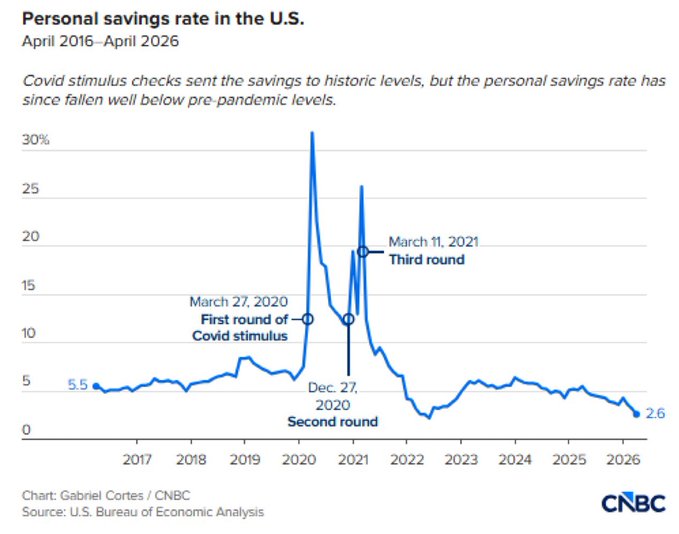
The chart accompanying this article shows the extraordinary increase in the U.S. personal saving rate during the pandemic and the subsequent decline. The original April 2026 estimate shown in the chart was 2.6%. BEA has subsequently revised April 2026 to 2.9%, and its latest available estimate puts the July 2026 personal saving rate at 3.0%. [bea.gov], [fred.stlouisfed.org]
At the same time, borrowing remains expensive. Federal Reserve data released September 8, 2026 reported approximately $1.357 trillion in outstanding revolving consumer credit in July. The Federal Reserve's reported average interest rate for credit card accounts assessed interest was 22.15% for May 2026. [federalreserve.gov]
New York Federal Reserve data provide another indication of household financial pressure. At the end of the second quarter of 2026, credit card balances stood at $1.26 trillion, auto loan balances at $1.71 trillion, and HELOC balances at $459 billion. The New York Fed also reported that new delinquencies for credit cards and auto loans remained elevated. [newyorkfed.org]
For an individual household, however, national statistics are secondary. What matters is whether your income can realistically service your debt.
The Debt Spiral: When Borrowing Becomes the Only Way to Keep Borrowing
One of the clearest warning signs of excessive consumer debt is when new debt is being used to service existing debt.
The pattern may look something like this:
Credit cards → personal loan → new credit cards → HELOC → balance transfers → another personal loan → cash advances → inability to make minimum payments.
A consumer may initially consolidate $30,000 of credit card debt with a personal loan. But unless the underlying monthly cash-flow deficit is corrected, the credit cards may gradually acquire balances again.
Now there is a personal loan and credit-card debt.
Another common situation involves homeowners who tap home equity to pay unsecured debt. The immediate monthly payment may improve, but using a HELOC or second mortgage to pay credit cards can also transform unsecured consumer debt into debt secured by the consumer's home.
That distinction can matter enormously when financial trouble develops.
"I Can Make the Minimum Payments, But I Will Never Pay These Cards Off"
That statement should not be ignored.
At high interest rates, a substantial portion of a credit-card payment may go toward interest rather than rapidly eliminating principal.
The CFPB explains that most credit-card companies calculate interest daily and that paying all or part of a balance sooner reduces the amount of interest paid. [consumerfinance.gov]
When consumers have multiple high-interest accounts, minimum payments can consume thousands of dollars each month while balances decline painfully slowly.
Ask a more useful question than simply:
Can I make this month's minimum payments?
Ask:
Is there a realistic path for me to repay all of this debt from my expected income without repeatedly borrowing additional money?
Those are very different questions.
Warning Signs That You May Be Financially Overextended
You may want to take a serious look at your financial situation if several of these sound familiar:
Credit Card Warning Signs
- You routinely carry balances on several credit cards.
- Credit cards are at or near their limits.
- You are making only minimum payments.
- You use one card because another card is maxed out.
- You depend on balance-transfer offers to stay afloat.
- You use credit cards for groceries, utilities, insurance or other ordinary necessities because cash is unavailable.
- Your balances remain approximately the same even though you pay hundreds or thousands of dollars every month.
- You have begun considering whether to simply stop paying your credit cards.
Personal Loan Warning Signs
- You obtained a debt-consolidation loan, but your credit-card balances returned.
- You now have multiple unsecured personal loans.
- You are searching for another personal loan merely to make existing payments.
- Your income is insufficient to pay your loans without borrowing again.
HELOC and Second-Mortgage Warning Signs
- An adjustable interest rate has increased the cost of your home equity line of credit.
- Your HELOC payment has become difficult to afford.
- You borrowed against your home's equity to pay credit cards but accumulated new credit-card balances afterward.
- You are worried about defaulting on a second mortgage or HELOC.
Auto Loan Warning Signs
- Your car payment is too high for your current income.
- You owe significantly more on the vehicle than you believe the vehicle is worth.
- You are using credit cards to make room in your budget for the automobile payment.
- You are afraid that missing payments may lead to repossession.
These problems can interact. A household may not have "a credit-card problem" or "a car-loan problem." The real problem may be that the household's combined debt obligations exceed sustainable cash flow.
Secured Debt and Unsecured Debt Are Not the Same
Before deciding what to pay, refinance, settle, surrender or default on, consumers should understand what is securing each obligation.
Unsecured debts commonly include:
- Credit cards
- Many personal loans
- Medical bills
- Certain lines of credit
Secured debts commonly include:
- First mortgages
- Second mortgages
- HELOCs secured by residential real estate
- Automobile loans
That difference matters.
A creditor holding collateral may have remedies concerning that collateral if the loan defaults. Consequently, blindly treating every creditor the same can overlook materially different consequences.
This is one reason a consumer struggling simultaneously with credit-card debt, a HELOC, a second mortgage and an unaffordable automobile loan may benefit from obtaining individualized advice before simply stopping payments across the board.
The Most Dangerous Strategy May Be Pretending Nothing Is Wrong
Consumers understandably try to preserve excellent credit.
But there is an important difference between protecting your credit and borrowing increasing amounts of money merely to postpone an unavoidable financial problem.
If your monthly numbers demonstrate that your debts cannot realistically be repaid, continuing to borrow without examining the entire situation can make the eventual problem larger.
Consider preparing a simple debt inventory containing:
DebtBalanceInterest RateMonthly PaymentSecured?Credit Card #1$__________%$_____NoCredit Card #2$__________%$_____NoPersonal Loan$__________%$_____Usually NoFirst Mortgage$__________%$_____YesSecond Mortgage$__________%$_____YesHELOC$__________%$_____YesAutomobile Loan$__________%$_____YesThen compare the required monthly payments against actual take-home income and necessary household expenses.
That exercise can reveal whether the issue is a temporary shortage or a structural debt problem.
What Happens If You Stop Paying Credit Cards or Personal Loans?
Default should not be treated casually.
Depending upon the creditor, contract and circumstances, failure to pay an unsecured debt can result in collection activity and potentially litigation.
The better question therefore is usually not:
"Should I just stop paying my credit cards?"
It is:
"If I cannot possibly continue paying all of these obligations, what are my available options, risks and priorities?"
Those options may depend on income, assets, home equity, the nature of each debt, possible creditor arrangements and whether the consumer's financial problem is temporary or permanent.
What Should You Do Before You Miss Payments?
If you can see the financial wall approaching, consider taking action while there is still time to understand the situation.
1. Stop looking at each debt separately.
Calculate your total debt, total minimum payments, interest rates and actual monthly cash flow.
2. Identify secured debts.
Determine which obligations are secured by your house, automobile or other property.
3. Determine whether the problem is temporary or structural.
A temporary reduction in income is fundamentally different from owing so much high-interest debt that repayment is unrealistic even at normal income.
4. Contact creditors about available assistance where appropriate.
Options vary by creditor and account. Consumers experiencing problems with credit-card accounts can review CFPB resources concerning credit-card management and consumer rights. [consumerfinance.gov]
5. Be cautious about moving unsecured debt onto your house.
Using home equity may reduce an interest rate or monthly payment, but consumers should understand the consequences of using their residence to secure debt that was previously unsecured.
6. Get advice before the situation becomes an emergency.
Waiting until there is a lawsuit, repossession threat, foreclosure issue or multiple delinquent accounts may reduce the amount of time available to evaluate alternatives calmly.
"I Have Too Much Debt. Do I Need a Lawyer?"
Not everyone experiencing debt problems needs an attorney.
But when a consumer has substantial credit-card debt, personal loans, collection accounts, an unaffordable car loan, a second mortgage, an adjustable-rate HELOC, threatened lawsuits, judgments or other significant financial obligations, legal questions can become intertwined with the financial ones.
The correct approach depends on the individual's circumstances.
The objective should not simply be to preserve every account at any cost.
The objective should be to understand the consumer's entire financial position and develop a path that is sustainable.
South Carolina Consumers Facing Overwhelming Debt
If you live in Charleston, Mount Pleasant, Summerville, North Charleston, Berkeley County, Charleston County, Dorchester County, or elsewhere in South Carolina and you already know that your debt payments are becoming impossible, consider evaluating the situation before the missed payments and collection notices begin piling up.
Searches such as:
- South Carolina credit card debt lawyer
- credit card debt attorney Charleston SC
- debt lawyer Mount Pleasant SC
- can't afford credit card payments South Carolina
- too much credit card debt what should I do
- help with personal loan debt
- HELOC payment too high
- adjustable rate HELOC payment increased
- can't afford my second mortgage
- can't afford my car payment
- credit card default lawyer
- credit card lawsuit attorney South Carolina
- what happens if I stop paying credit cards
- how to deal with overwhelming debt
- debt settlement attorney South Carolina
- consumer debt attorney Charleston
- help before defaulting on credit cards
all reflect variations of the same underlying problem:
The consumer needs a realistic plan because continuing the present payment cycle may no longer be financially sustainable.
Talk With Traywick Law Offices Before a Financial Problem Becomes a Financial Emergency
If you can see a default coming, there may be value in understanding your options before it happens.
Traywick Law Offices, LLC can evaluate the circumstances surrounding your debt and help you understand the legal issues that may affect your situation.
Traywick Law Offices, LLC
707 Ventura Place
Mount Pleasant, South Carolina 29464
843-343-5092
dpt@traywicklaw.com
www.traywicklaw.com
This article is provided for general informational purposes and is not legal advice. The appropriate course of action depends upon the facts of each person's financial circumstances.