Stop Means Stop: How to Opt Out of Debt Collector Contact Under the FDCPA
A collector kept texting a consumer about a $328.84 balance — even after its own system confirmed he was unsubscribed, and even after he texted "Stop" a second time. Now it faces a proposed nationwide class action. You have a federal right to cut off a debt collector's contact for good. Here's how the opt-out works, what qualifies, and when continued contact becomes a lawsuit.
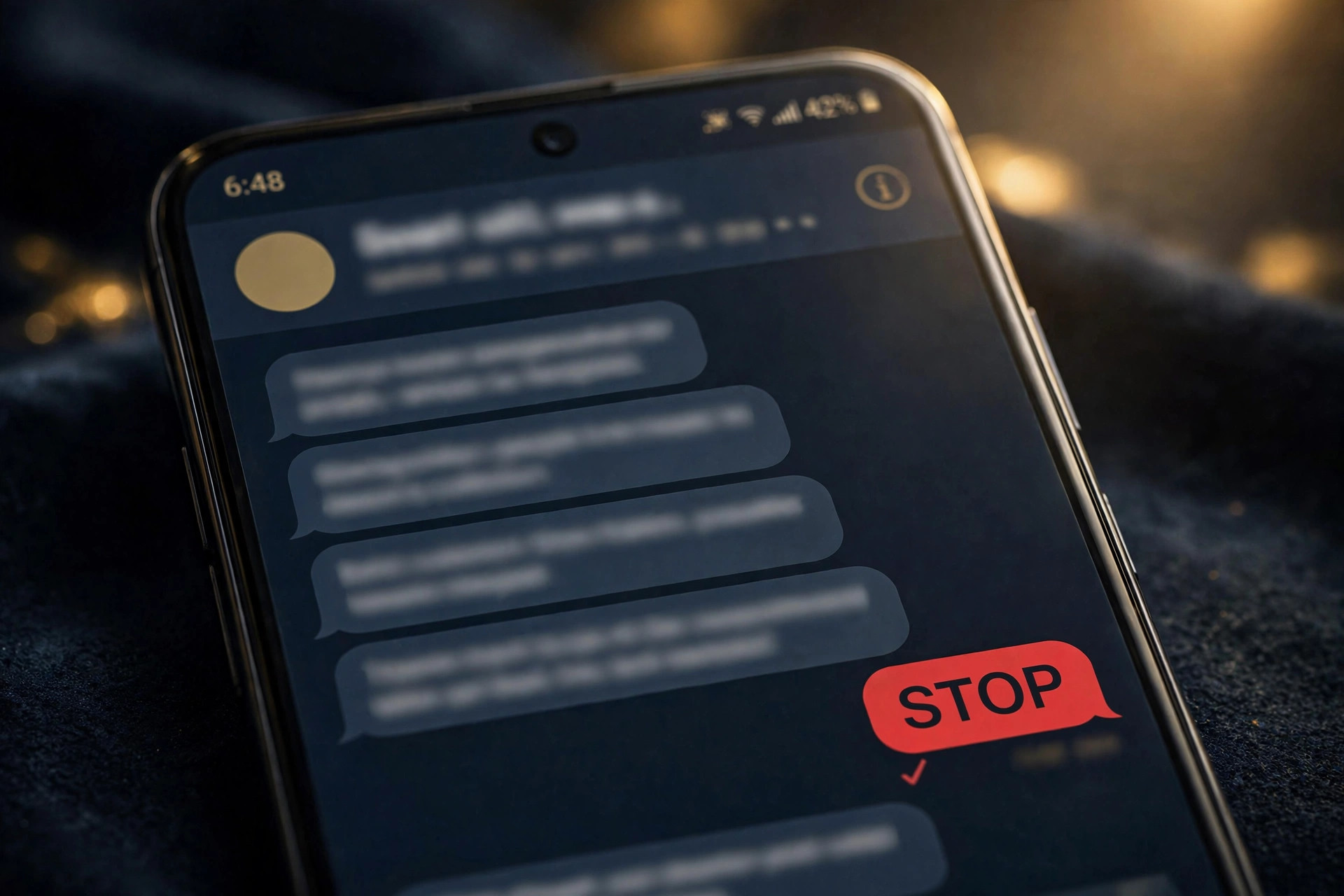
A debt collector texted a consumer about a $328.84 water-delivery balance. The consumer wrote back that he had no water service — his water comes out of the tap — and asked the collector to stop "harassing" him. The collector's own system immediately confirmed he was unsubscribed and would receive no more texts.
The texts kept coming anyway. On August 17, the consumer texted "Stop." More texts followed.
Now the collector faces a proposed nationwide class action in an Illinois federal court, alleging violations of Section 1692c(c) of the Fair Debt Collection Practices Act — the provision that lets a consumer cut off a debt collector's contact entirely. (Note: this account is based on the complaint as reported by AccountsRecovery.net on October 6, 2026. The defendant has not yet responded; the claims are accusations unless and until proven.)
The case is a live illustration of a right most consumers don't know they have: you can order a debt collector to stop contacting you, and once you do it the right way, every contact after that can be worth money. Here's how the opt-out works, what counts, what doesn't, and when to call a lawyer.
Your Federal Right to Cut Off Contact: 15 U.S.C. § 1692c(c)
The Fair Debt Collection Practices Act, the federal law that governs third-party debt collectors, contains a provision with a blunt name: "Ceasing communication." It says that if a consumer notifies a debt collector in writing that the consumer refuses to pay the debt, or that the consumer wishes the collector to cease further communication, the collector shall not communicate further with the consumer about that debt.
That is the opt-out. One written notice, and the collector's calls, texts, letters, and emails about that debt are supposed to stop.
Three narrow exceptions exist. After a valid opt-out, the collector may contact you only:
- To tell you it's done — to advise that its further collection efforts are being terminated;
- To warn you about remedies it ordinarily uses — to notify you that the collector or creditor may invoke specified remedies it ordinarily invokes; or
- To tell you it's about to act — to notify you that the collector or creditor intends to invoke a specific remedy, like filing a lawsuit.
Anything else — another "friendly reminder," another payment link, another settlement offer — is a communication the statute forbids.
One more detail straight from the law: if you send your notice by mail, it is complete upon receipt. That is why proof of delivery matters, as we'll cover below.
What Counts as "In Writing"? The Text-Message Question
The statute was written in 1977, when "in writing" meant paper. Courts have had to drag it into the texting era — and consumers have mostly been winning that fight.
Texts count. In March 2026, the U.S. District Court for the Middle District of Pennsylvania granted summary judgment for a consumer and a class of nearly 5,000 people, holding that replying "STOP" to a collector's text satisfies the FDCPA's writing requirement (as reported by Orrick's InfoBytes, April 3, 2026). The collector's CEO admitted under oath that the company kept texting people after opt-outs because of a purported "computer bug" — and admitted the company had never even told its texting vendor to honor STOP requests.
Emails and portal messages count, too, where the collector accepts electronic communications from consumers. The Consumer Financial Protection Bureau's Regulation F commentary recognizes electronic communications as writings for the statute's parallel provisions, and courts apply the same common-sense reading to cease-communication notices.
The practical rule: if your opt-out is in a form you can save, screenshot, or print — a text, an email, a portal message, a letter — it counts. What matters is that you can prove you sent it and what it said.
What Does NOT Count as Opting Out
This is where consumers lose cases they should win. The following do not trigger the cease-communication protection:
- Ignoring the calls. Silence is not a notice. The collector has no duty to read your mind.
- Blocking the number. Blocking stops the ringing, but it isn't a communication to the collector at all — and it creates no record.
- Telling them once, verbally, on a call. This is the danger zone. The statute says "in writing," and courts are divided on whether an oral "stop calling me" qualifies. Some judges accept a clearly recorded verbal cease request; many do not. Never rely on a verbal request alone — follow it up in writing the same day.
- A verbal dispute about the debt. Disputing what you owe is a different right under a different provision (§ 1692g), with its own writing requirement for the strongest protections. Saying "this isn't my debt" on the phone does not cut off contact.
The pattern in the Illinois complaint shows why the written record matters: the consumer's first opt-out was a text the collector's system acknowledged. That acknowledgment is the kind of evidence that turns a "he said, she said" into a documented violation.
How to Opt Out So It Sticks: A Step-by-Step
You don't need a lawyer or legal jargon. You need the right words, sent the right way, with proof.
Step 1: Use the magic words. Write: "I am notifying you in writing that I wish you to cease all further communication with me regarding this debt, under 15 U.S.C. § 1692c(c). Do not call, text, email, or write to me about this debt again." You can also add that you refuse to pay, but the cease-communication language alone is enough.
Step 2: Send it in a way you can prove. Best to worst: - Certified mail, return receipt requested, to the collector's business address — the gold standard; the statute itself says mailed notice is complete upon receipt. - A text reply ("STOP" plus the cease-communication sentence) — screenshot the sent message and any confirmation reply. - An email with a clear subject line ("Cease all communication — account [number]") — save the sent copy. - The collector's web portal, if it has one — screenshot the submission confirmation.
Step 3: Keep everything. Save the letter copy, the certified-mail receipt, the green card when it comes back, the screenshots, the emails. Date-stamp it all. If this ever becomes a lawsuit, your file is your case.
Step 4: Watch the calendar. Note the date the collector received your notice. Everything after that date — other than the three narrow exceptions — is a potential violation.
One honest caveat: opting out stops the contact, not the debt. The collector can still sue you within the statute of limitations, and can still report the debt to the credit bureaus. If you get served with a lawsuit, do not ignore it — talk to a lawyer immediately. Whether you have leverage depends on your facts, which is exactly what a consultation is for.
They Contacted You Anyway — Do You Have a Case?
If you sent a qualifying written opt-out and the collector contacted you about the debt anyway — beyond the three exceptions — you likely have an FDCPA claim. Each prohibited communication is a separate violation.
You don't need to show the collector meant to break the law. The FDCPA is essentially a strict-liability statute: if the communication happened after a valid opt-out and doesn't fit an exception, the violation is established. The collector's intent goes to how much you recover, not whether it violated the law.
One practical note on proof: courts now expect more than a bare technical violation. Since the Supreme Court's standing decisions, you should be ready to describe real harm — the time you spent, the disruption, the frustration, the unwanted texts lighting up your phone at dinner. The Illinois complaint does exactly this, alleging wasted time, annoyance, and even battery drain. Document all of it contemporaneously: a simple log with dates, times, and what each contact said.
And act promptly. The FDCPA gives you one year from the date of the violation to file suit (15 U.S.C. § 1692k(d)) — and the Supreme Court held in Rotkiske v. Klemm, 589 U.S. ___ (2019), that the clock starts when the violation happens, not when you discover it. No discovery rule. Don't sit on it.
What Each Illegal Contact Is Worth
Under 15 U.S.C. § 1692k, a collector that violates the FDCPA is liable for:
- Your actual damages — anything the violations actually cost you or put you through;
- Statutory damages of up to $1,000 per lawsuit (not per contact — the court sets the amount considering how frequent and persistent the violations were, how egregious, and how intentional); and
- Your attorney's fees and court costs, paid by the collector if you win.
That fee provision is why consumer lawyers take these cases: the collector pays your lawyer, not you. In a class action, the statute allows up to the lesser of $500,000 or 1% of the collector's net worth for the class as a whole — which is why collectors that text thousands of people after opt-outs, like the defendants in the Pennsylvania and Illinois cases, face class exposure.
"Our System Glitched": The Bona Fide Error Defense
Collectors caught texting after opt-outs almost always reach for the same excuse: it was a mistake — a computer bug, a vendor error, a list that didn't update. The FDCPA has a defense for that, but it's narrower than collectors wish.
Under § 1692k(c), a collector escapes liability only if it proves by a preponderance of the evidence that the violation was unintentional, resulted from a bona fide error, and happened despite "procedures reasonably adapted to avoid" that error. All three. Miss one, and the defense fails.
Two points gut the "glitch" excuse in opt-out cases:
- No procedures, no defense. In the Pennsylvania case, the court rejected the defense outright because the collector had never implemented any procedure to make its texting vendor honor STOP requests. A bug you never tried to prevent isn't bona fide.
- Legal mistakes don't count at all. The Supreme Court held in Jerman v. Carlisle, 559 U.S. 573 (2010), that the bona fide error defense covers factual and clerical errors — not a collector's mistaken reading of what the law requires. "We thought a second text was fine" is not a defense.
When the collector's own system confirmed the unsubscribe — as alleged in the Illinois complaint — the glitch story gets even weaker. The system knew. It said so in writing.
Why Post-Opt-Out Texting Is Class-Action Territory
Look at the pattern across both 2026 cases: a collector texts thousands of consumers, some text STOP, the system logs the opt-outs, and the texts continue. That uniformity is catnip for class actions — the same conduct, the same system records, the same legal question, repeated across thousands of phone numbers. The Pennsylvania class covered 4,984 phone numbers from STOP replies alone. The Illinois complaint seeks to represent everyone in the country who got a text from the defendant within the past year after asking in writing to be left alone.
For consumers, that means your individual experience may be part of something much bigger — and for collectors, it means a broken opt-out system isn't a small mistake. It's a business model with a price tag.
What To Do Right Now
If a debt collector won't leave you alone:
- Send the written opt-out today — certified mail if you can, text or email with screenshots if you can't wait.
- Save everything — every text, every voicemail, every letter, with dates.
- Don't delete the message thread. Your phone is evidence.
- Note the three exceptions. A letter saying "we're closing your file" or "we intend to sue" after your opt-out is allowed. A fourth "just checking in" text is not.
- Call a consumer lawyer if contact continues. Whether you have leverage depends on your facts — the strength of your opt-out proof, the number of post-opt-out contacts, and what they said.
If a collector is texting or calling you after you told it to stop, Traywick Law Offices can evaluate whether those contacts are FDCPA violations — and what they're worth. Debt collectors that ignore a valid opt-out don't get to shrug it off as a glitch. Under federal law, stop means stop.
This article is for information about Traywick Law Offices' consumer-protection services, not legal advice. Case details about the Illinois complaint are drawn from the October 6, 2026 AccountsRecovery.net report; the complaint's allegations are unproven unless and until a court rules. Statutes cited as currently in effect per the U.S. Code.