How to Clear a UCC Filing You Never Authorized in South Carolina
A company filed a UCC lien against your South Carolina business and you never signed anything? South Carolina law gives you a demand, a 20-day clock, a self-help termination, and damages. Here is the full playbook — and where do-it-yourself stops working.
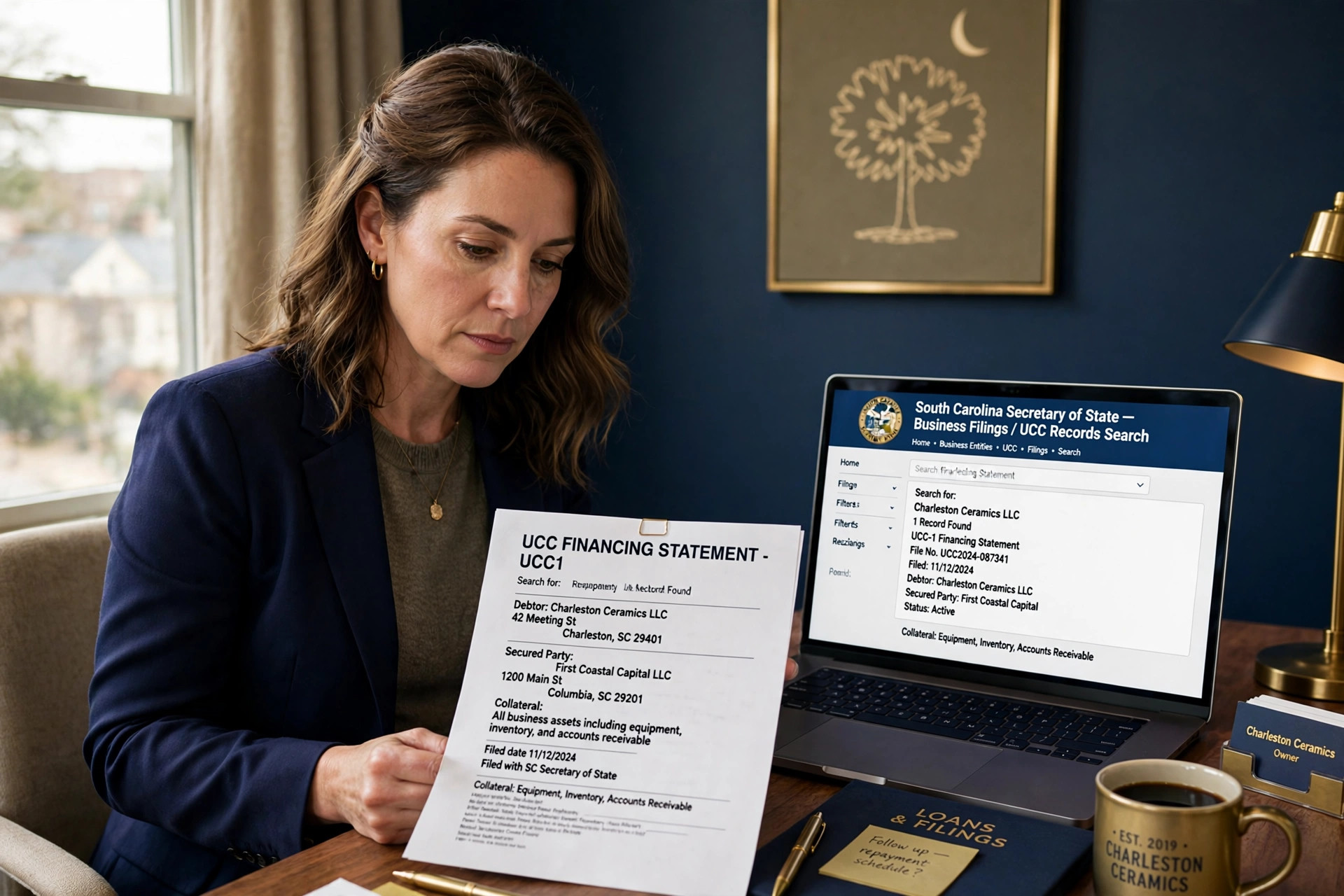
You did not borrow this money. You did not sign this agreement. But somewhere in the South Carolina Secretary of State's records, a company you may never have heard of claims a lien on everything your business owns — and the lender you actually want to work with just found it.
That is how most of these cases start. Not with a lawsuit. With a phone call from a bank, a factoring company, or an equipment lender saying your deal is on hold. This post is the playbook for clearing a UCC filing you never authorized: what the law says, the exact steps that work, and the point where doing it yourself stops working.
A UCC Lien Was Filed Against Your Business and You Never Signed Anything
The discovery moment is almost always the same. You apply for something real — an SBA loan, a bank line of credit, equipment financing, or a switch to a new factoring company. Underwriting runs a UCC search. The search comes back with a financing statement naming your business as debtor and claiming collateral like "accounts receivable and all assets." Your new lender will not fund until it is gone.
The scenarios behind these filings repeat across industries. Trucking carriers describe factoring and fuel-card companies filing a UCC-1 after a sales call, a quote request, or a product mailed to them that they never agreed to take — then refusing to send the letter of release the new factor needs. Restaurant and retail owners describe merchant cash advance funders filing blanket liens off an application or a broker submission, sometimes before any money ever moved. Equipment buyers pay off a lease and learn years later that nobody ever filed the termination. Different industries, same problem: paper you never agreed to, sitting in a public index, treated as real by every lender who sees it.
Here is the part nobody tells you at the bank: a bogus filing does not have to be paid off. It has to be cleared. Those are very different fights.
Can a Lender File a UCC Without Your Permission? No — Here's the Law
South Carolina law is direct on this. Under S.C. Code § 36-9-509(a), a person may file an initial financing statement only if the debtor authorized the filing in an authenticated record. And under § 36-9-510(a), a filed record is effective only to the extent it was filed by a person entitled to file it.
Read those together and the result is powerful: a UCC-1 filed without your authorization is legally ineffective from the day it was filed. It is not a valid lien you owe money on. It is a piece of paper in an index that should never have been there.
One line matters, and it is where these cases are won and lost. Signing a security agreement counts as authorization to file against the collateral that agreement describes (§ 36-9-509(b)). But a quote request is not a security agreement. A credit application standing alone, a phone call, a website form, or an unsolicited product mailed to your business is not a security agreement either. Filers count on owners blurring that line. Do not. One caveat, because filers hide in it: authorization can also come from a separate record you authenticated, which is why these fights so often turn on the exact words of anything you did sign. Language buried in an application counts only if it actually grants a security interest or agrees to the filing — read the document, not the sales pitch. If you never signed an agreement granting a security interest and never authenticated a record authorizing the filing, the filing was never authorized — and everything below follows from that.
Step One: Run a Certified South Carolina UCC Search
You cannot terminate what you have not identified. Before anyone sends a letter, get the official picture of what is on your name.
All central UCC filings in South Carolina run through the Secretary of State's UCC Online system. A certified search — the UCC-11 search report — is the filing office's official report of what the index shows under your business's exact legal name, with copies of the records found. Lenders, factors, and courts rely on the certified version, so get that one.
Write down four things from every record the search returns: the initial filing number, the filing date, the exact debtor name as indexed, and the exact name and address of the secured party. Also note the collateral description and the lapse date. A financing statement generally stays effective for five years, so "just wait for it to expire" is not a plan for a business that needs financing this quarter.
Search your exact legal name from your articles of organization or incorporation. UCC indexing is name-based and unforgiving. Also search common variants — a predecessor name, a trade name, a near-match — because filers make name errors and lenders' search logic matches names that are merely close.
Why Is the Name on the Filing One You've Never Heard Of?
Owners are often stunned to find the secured party is a company they have never dealt with. That is common, and it is not a typo. The brand that called you, the company whose product showed up in the mail, and the name on the UCC-1 can be three different entities. Filers use affiliated companies, assignees, and filing agents or "representative" entities to put filings on the index.
The law has a term for the name that controls: the secured party of record. The termination duty described below runs to the party named on the filing — not to the salesperson, not to the brand name on the brochure. Many cleanup efforts fail because the owner spent months demanding a release from the company they talked to while the company on the record heard nothing. Identify the secured party of record from the certified search, and make sure your demand reaches them. Send it to the brand you dealt with too, but the record name is the one that counts.
The Authenticated Demand: A Demand Letter to Terminate a UCC Filing
The engine of the whole cleanup is a written demand under § 36-9-513. The statute calls it an authenticated demand — in plain terms, a signed writing from the debtor that identifies the filing and demands that a termination statement be filed.
A demand that works does five things. It identifies the debtor by exact legal name. It identifies the initial financing statement by file number. It states the ground: you did not authorize the filing of the initial financing statement (or, in payoff cases, that nothing is owed and no commitment to advance remains). It demands that the secured party of record file a UCC-3 termination statement. And it is sent a way that proves receipt — certified mail with return receipt requested is the classic proof, kept alongside the signed green card when it comes back.
Why the obsession with delivery proof? Because the statutory clock runs from receipt of the demand, not from the date on your letter. Owners lose weeks arguing about when a letter was mailed. A green card ends the argument. Keep the demand, the mailing receipt, and the return receipt together; they become exhibits later if you need them.
How Long Does a Lender Have to Terminate a UCC Filing? Twenty Days
In commercial cases, § 36-9-513(c) gives the secured party 20 days after it receives your authenticated demand to cause the secured party of record to file the termination statement or send one to you. One of the express grounds is the one that fits this post: the debtor did not authorize the filing of the initial financing statement (§ 36-9-513(c)(4)). The same 20-day rule covers the paid-off cases — nothing owed, no remaining commitment to lend.
Twenty days is not a suggestion. It is a deadline with consequences on the other side of it, and filers who run this playbook know most owners have never heard of it. They slow-walk letters of release, invent fees, and hide behind renewal windows because delay is the leverage. A dated, receipt-proved demand changes the posture: now every day of delay is theirs to explain, not yours.
If the 20 days pass with no termination filed or sent, you have two more moves — and the first one surprises people.
What If the Funder Will Not File the Termination? You Can File the UCC-3 Yourself
South Carolina law does not leave you waiting on the company that wronged you. Under § 36-9-509(d)(2), if the secured party of record has failed to file or send a termination statement as § 36-9-513 requires, the debtor may file the termination statement itself — provided the filing indicates that the debtor authorized it. Once that termination statement is filed, the financing statement it relates to ceases to be effective (§ 36-9-513(d)).
Precision matters here. The self-filed UCC-3 must be tied to the correct initial filing number, and it must carry the debtor-authorized indication. Nothing on the face of a UCC-3 proves it was authorized, which is why lenders sometimes scrutinize debtor-filed terminations. Your paper trail — the demand, the certified-mail receipts, the blown 20-day deadline — is what answers that scrutiny. Do the demand step right and the self-help step holds.
This is also where owners most often need a lawyer's eye before filing. If the filer produces a signed agreement and claims you did authorize the filing, the dispute stops being clerical and becomes a document fight about what that agreement actually says. File the self-help termination on the wrong facts and you have made your problem worse, not better.
How to Dispute a UCC Filing: The UCC-5 and the Secretary of State's Cancellation Power
There is a second track, and in South Carolina it has real teeth.
Any person may file an information statement — the UCC-5 form — about a record indexed under their name if they believe the record is inaccurate or was wrongfully filed (§ 36-9-518(a)–(b)). Be clear-eyed about the limit: standing alone, an information statement does not change the effectiveness of the filing (§ 36-9-518(c)). It is a flag on the record, not a deletion.
But a properly framed UCC-5 triggers something bigger in South Carolina. Section 36-9-516(b)(8) makes a record rejectable if the Secretary of State determines it was not created under the UCC or was intended for an improper purpose — the statute names fraud, hindrance, harassment, and wrongful interference. When an information statement alleges the record was wrongfully filed on that ground, the Secretary of State must decide without undue delay. The Secretary can require both sides to produce more information — expressly including a copy of the claimed security agreement. If the Secretary finds the filing wrongful, the record is cancelled and is void with no effect (§ 36-9-518(e)).
Understand what that does to the fight. The filer must finally produce the agreement it claims you signed — or lose the record. For a business whose "authorization" was a phone call or a product in the mail, that is usually the moment the story collapses. The secured party can appeal a cancellation to the Administrative Law Court within 30 days (§ 36-9-520(e)), so a cancelled record is not always the last word. But it reverses who has to sue, and on whose timeline.
Proving You're Clear: The Package Your New Lender Actually Wants
Getting the termination filed is the legal win. Getting funded is the business win, and they are not automatic. Underwriters do not read statutes; they read records. After the termination posts, run a fresh certified search and assemble the proof package: the filed termination statement, your authenticated demand with its delivery receipts, and the new search showing the record terminated or cancelled.
Hand that package to your lender, factor, or broker in writing and ask for the hold to be released. If the filer was a factoring company holding freight money or a lender conditioning a closing, this paper is what moves you out of the "lien problem" pile. Where money is still legitimately owed to someone in the chain, a negotiated payoff, subordination, or partial release may be the faster route to closing — that is a judgment call to make with the actual contracts in hand, not a guess.
Can I Sue Over a Wrongful UCC Filing? The Damages Are Real
Termination clears the record. It does not pay you back for what the filing cost you. South Carolina law addresses that too.
Under § 36-9-625(b), a person who fails to comply with the UCC is liable for damages in the amount of any loss caused by the failure — and the statute expressly includes the loss from your inability to obtain alternative financing, or the increased cost of that financing. The loan you lost, the worse rate you took, the funding your business could not draw while the bogus filing sat there: that is the damages ledger, not an abstract injury. On top of actual damages, § 36-9-625(e) adds flat penalties — $500 from a person who files a record it was not entitled to file, and another $500 from a person who fails to cause the termination statement to be filed or sent after demand. A court can also order or restrain noncompliant conduct (§ 36-9-625(a)) — useful when a filer is sued by a creditor over the same conduct or keeps enforcing a dead filing, and the starting point for creditor lawsuit defense if the filer tries to collect on it.
Then there is the South Carolina Unfair Trade Practices Act. Filing a lien you had no right to file, and refusing to release it to hold a customer hostage, is the kind of conduct § 39-5-20 makes unlawful. Under § 39-5-140, a person who suffers an ascertainable loss can recover actual damages and reasonable attorney's fees — and if the violation was willful or knowing, the court must treble the damages. One hurdle matters: a SCUTPA claim must be capable of affecting the public interest, which courts commonly test by whether the conduct can repeat. That is why complaint patterns against the same filer, run on other businesses the same way, are evidence and not just background. Our consumer fraud practice handles these claims alongside the UCC cleanup.
What It Costs, How Long It Takes — and Where DIY Stops Working
The filing-office costs are small, which is exactly why the filers' business model works: the filing costs them almost nothing, and they bet you will pay a "release fee" instead of fighting. As of this writing, the Secretary of State's online fees run $8 for a UCC-3 filing plus an $8 SC.gov service fee — a debtor-filed termination comes to about $16 all-in — and a certified search with copies costs in the same modest range. Quote fees as current and re-check them; they change.
The timeline is set by the statute, not by the filer: demand delivered, 20 days, then your termination or the Secretary of State track. A clean unauthorized-filing case can move from discovery to a terminated record in a matter of weeks.
DIY stops working in predictable places. The filer produces a signed agreement and you have to fight about what it authorizes. The filing was made by an agent entity and identity itself is disputed. There are stacked liens from multiple funders and a new lender needs subordination, not just terminations. Money is genuinely owed and the real fight is contract terms, notice windows, and buyout math. Or the filer simply ignores everything and the next step is court. Those are fact fights, and they are where leverage is built or lost.
Talk to a UCC Lien Lawyer in South Carolina Before You Pay Anyone a "Release Fee"
If a company is demanding money to release a filing you never authorized, stop. Do not pay it, do not sign anything new, and do not "confirm" anything on a recorded call. Whether a bogus filing can be terminated in weeks, cancelled by the Secretary of State, or turned into a damages claim depends on your documents — the search, the demand trail, and whatever the filer claims you signed.
Traywick Law Offices clears unauthorized and stale UCC filings for South Carolina businesses and pursues the damages that go with them. Send us the filing you found through our legal opinion intake or contact the office for a case review. We will tell you which track your filing belongs on — demand, self-help termination, Secretary of State cancellation, or suit — and what it should cost them, not you.