Sewage, Septic Smells, and Water Running Off a Neighbor's Lot: Your South Carolina HOA Remedies
When sewage, greywater, or stormwater flows from a neighbor's lot onto yours, South Carolina law gives you more than one path: surface water rules with a nuisance exception, trespass for a physical flow, covenant enforcement inside the HOA, and a health complaint that creates a written record.
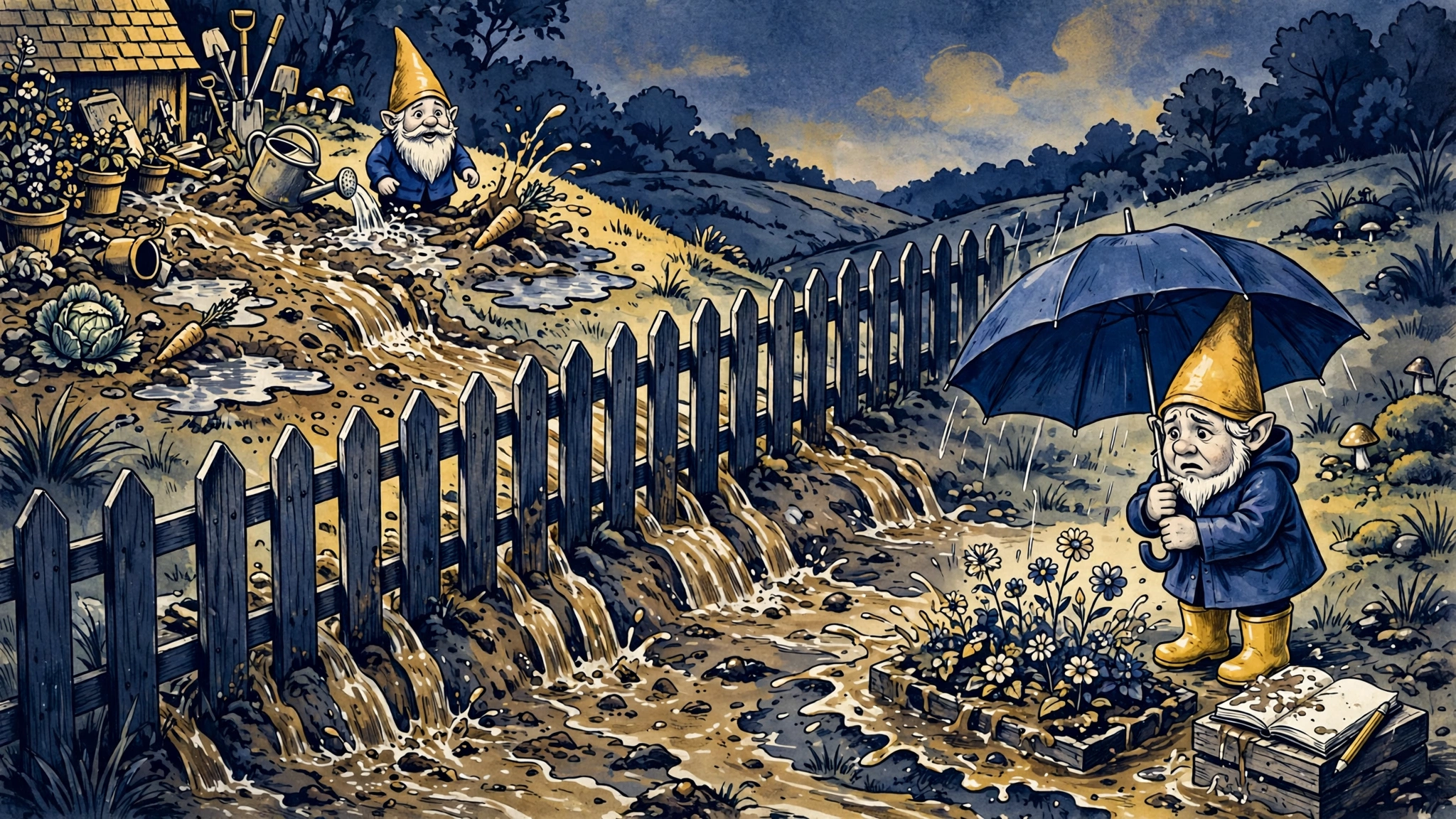
You step into your yard and the ground is wet on a dry day. The low corner smells like a drain. After each rain, muddy water pours off the lot next door and pools against your house. Or the swale that used to carry stormwater away now sits blocked, and the water has nowhere to go but into your crawl space.
Something physical is leaving one lot and entering another. That fact changes the law, the proof you need, and the fix you can ask for. You still start with the covenants and a written record. You add one step noise cases do not have: a health complaint when sewage is on the ground.
This guide covers South Carolina surface water rules, the line between trespass and nuisance, the covenant route inside an HOA, and the remedy ladder from written notice to court order. Our broader South Carolina HOA and POA homeowner rights guide covers homeowner rights across the association.
What is actually flowing onto your lot?
Start by naming the flow. Three patterns show up again and again.
The first is a failing septic system. Effluent surfaces near the shared line. The ground stays soggy. The stench is strong and steady. Flies gather. In the worst cases, raw sewage reaches the surface where children and pets walk.
The second is greywater discharge. Water from sinks, showers, or laundry is drained outside instead of into a proper system. Over time it leaves a slimy, damp patch and an odor that does not match rainwater.
The third is redirected stormwater. A lot is regraded, a swale is blocked, or a new driveway sheds water in a new direction. Rain that once ran to the street now sheets across your lot or pushes under your home.
Note whether the flow happens only during rain, only after heavy water use next door, or all the time. A constant flow points away from rain runoff. A flow tied to storms points to grading. That sorting guides the inspector, the board, and the court.
Does South Carolina let a neighbor send water onto your land?
South Carolina follows the common-enemy rule for surface water, with a nuisance exception. The leading case is Lucas v. Rawl Family Ltd. Partnership, 359 S.C. 505, 598 S.E.2d 712 (2004). In Lucas, clear-cutting on one tract redirected surface water and flooded the neighbors' land. The court kept the common-enemy idea, which treats surface water as something each owner may deal with on his own land, but it did not give owners a free pass to harm the lot next door.
The nuisance exception is the part homeowners need. Quoted in Lucas, the test from Silvester v. Spring Valley Country Club, 344 S.C. 280, 543 S.E.2d 563 (Ct. App. 2001), asks whether the defendant unreasonably interfered with the ownership or possession of the plaintiff's land. Work on your own lot may be lawful in the abstract and still be unreasonable in how it lands on your neighbor.
That framing helps in grading fights. A neighbor may grade, build, or clear trees. The question is whether the work, as done, unreasonably sends water onto you. Photos of a new slope aimed at your fence, a filled swale, or a pipe outlet at the lot line speak to that test.
The rule has limits. Rain is natural, and low land collects water. Your case grows stronger when you can show a change: a before and an after, a new flow path, or a blocked outlet. Keep old photos that show how the land drained when you bought the home.
When does runoff or sewage become a nuisance?
A private nuisance in South Carolina is a substantial and unreasonable interference with the use and enjoyment of land. That standard comes from Ravan v. Greenville County, 315 S.C. 447, 434 S.E.2d 296 (Ct. App. 1993). Substantial means the harm is real and weighty, not slight or passing. Unreasonable means the conduct fails a weighing of the rights of both households. Reasonableness is usually a question for the jury, judged on the facts.
Apply that test to what you have lost. A yard you cannot use. A crawl space that stays wet. A smell that drives your family indoors day after day. A home that is hard to sell because a buyer finds the condition at the fence line. Those are losses of use and enjoyment.
South Carolina law also knows a narrower idea: a nuisance in itself. Lucas states the test at 359 S.C. 512 as "whether the nuisance has become dangerous at all times and under all circumstances to life, health, or property." Raw sewage surfacing on a lot can be argued toward that category, because sewage on the ground is a health risk in any season and under any normal use of a yard. Present that point for what it is: an argument to make with counsel on strong facts, not a holding that any court has issued about a home septic system.
Timing and notice matter too. A condition that runs for weeks after written notice shows both substantial harm and unreasonable conduct.
Moving in after the condition started does not, by itself, bar a claim. The court held in Brooks v. Council of Co-Owners, 314 S.C. 242 (1994), that coming to the nuisance is not a bar in South Carolina.
Is it trespass, nuisance, or both?
The two claims cover different things. The South Carolina Supreme Court drew the line in Babb v. Lee County Landfill SC, LLC, 405 S.C. 129, 747 S.E.2d 468 (2013). Trespass requires an intrusion by a physical, tangible thing. Nuisance covers a broader range of interference with use and enjoyment, even when nothing physical crosses the line.
Flowing water and sewage are physical. When runoff, effluent, or greywater crosses onto your lot, a trespass claim belongs in the discussion alongside nuisance. The flow itself is the intrusion. Mud, waste, and standing water left behind are part of that same entry.
Odors alone sit on the other side of the line. Invisible odors, by themselves, are not a trespass under Babb. A negligence claim based on offensive odors may proceed if all of its elements are proved, and odors are classic nuisance facts when they are strong and steady. Prove the flow, not just the smell, when a flow exists.
Damages under Babb shape expectations. For a temporary nuisance, damages are limited to lost rental value. For a lasting nuisance, damages are limited to the full market value of the property where no restoration or cleanup costs are claimed. In most cases, stopping the flow matters more than a damages award alone.
What do your HOA covenants add?
Inside an HOA, you hold a contract tool on top of the court claims. Recorded declarations in South Carolina often bar the exact conditions in this post, and they give the board a way to act without waiting for a lawsuit.
The declaration for Magnolia Phase 1 at Cane Bay in Berkeley County, recorded in 2012, states in paragraph 11 that noxious or offensive activity is barred, along with anything that may become an annoyance or nuisance to other owners. Paragraph 14 goes further on upkeep. It lets the board, in its discretion, treat an owner's failure after notice to maintain the lot and the dwelling exterior as a nuisance to other owners. The board may then correct the condition itself and charge the cost back as part of the assessment.
The declaration for Croghan Landing in Charleston County, recorded in Book F317 at page 844, states in paragraph 34 that noxious or offensive activity is barred, and that no thing may exist that diminishes or destroys other owners' enjoyment of their property.
Your declaration will have its own words, and the words control. Pull the recorded copy, find the nuisance, maintenance, and drainage clauses, and quote the section number in your complaint. A failing septic system fits a noxious-activity clause directly. A blocked swale may fit a drainage clause, a maintenance clause, or both.
Note who may enforce. Some declarations also let an owner sue to enforce. If the board will not move, that language decides whether you may file your own covenant claim.
Should you report surfacing sewage as a health complaint?
Yes, when sewage is on the ground, make that call early. Surfacing sewage is also a health complaint that homeowners can report to their county health and environmental authorities. You do not need to win a legal argument before you report a health condition in your yard. The report protects your family, and it creates a record made by someone with no stake in the neighbor fight.
Ask for a visit while the condition is present. Show the inspector the wet area, the flow path, and the dates the condition has run. Ask for the findings in writing. An inspector's written findings become strong evidence. They can confirm the source, describe the condition in neutral terms, and note any correction the owner is told to make. Boards and judges give that kind of paper real weight, because it does not come from either household.
Keep a copy of every report with your log. If an inspector cannot see the flow on a dry visit, your dated photos from a wet day fill the gap. Stay on your land, keep pets and children away from the area, and let professionals handle contact with waste.
A health complaint is a step, not the whole case. It does not award damages and does not replace a covenant complaint or a court claim. File it alongside the HOA complaint, not instead of it.
How do you prove where the water and waste came from?
Source proof wins these cases. The neighbor will say the water is rain, the low spot is natural, or the smell comes from somewhere else. Your file should answer each claim with a dated record.
Build that record the way you would for any pattern next door. Our guide on how to document neighbor harassment covers the same habits, and they apply here with additions for a physical flow. Log the date, the start and stop time, the weather, and what you saw and smelled. Take photos and short video from your own lot. Show the source area at the fence line, the path across your yard, and the pooling or damage at the end of the path, all in one clip when you can.
Photograph the same spots from the same angles each time, so change is easy to see. Keep a sketch showing your home, the fence, the swale, and the flow path. Note losses as they happen and save the invoices.
Witnesses help. A second household that sees the flow undercuts the claim that you are too sensitive. A professional who puts findings in writing helps even more. Ask: where is this coming from, and what would stop it? Get the answer in the report.
Stay off the neighbor's lot unless you have clear permission. Proof gathered by trespass of your own weakens your case.
What should you ask the neighbor and the HOA to do?
Ask for the fix, in writing, in terms a person can act on. A good notice names the condition, the dates, and the harm. It asks for specific steps: repair the septic system and stop the surfacing, end the greywater discharge, reopen the swale, regrade the area that now sends water onto your lot, or install a drainage fix that carries the water to a lawful outlet. It sets a clear date for a response and a plan. It stays flat in tone.
Send one written notice to the neighbor. Keep a copy and proof of delivery. Then file a written HOA complaint that quotes your covenant sections, attaches the log and photos, and includes any health complaint findings you hold. Ask the board for the steps its documents allow: a violation notice, a hearing, and enforcement until the condition stops. Where your declaration follows the Magnolia form, paragraph 14 is worth naming, because it addresses a board fix for a maintenance failure after notice, with the cost charged back as part of the assessment.
Keep logging while both tracks run. A flow that continues after written notice is the strongest fact in the file. If the neighbor proposes a fix, get the plan and dates in writing, and photograph the area during the next rain to see whether it worked.
If the problem has grown into threats or conduct aimed at you as a person, that is a second track. Read our guide on whether you can sue a neighbor for harassment in South Carolina and raise both tracks with counsel.
What remedies can a court order?
A court can order the flow stopped, and in the right case it can award money for the harm done. The core ask in a sewage or runoff case is an injunction: a court order that requires the neighbor to stop the discharge, repair the system, restore the drainage path, or complete a fix that ends the intrusion. Money alone does not dry a yard. An order aimed at the source does.
South Carolina courts weigh the equities when they shape that relief. O'Cain v. O'Cain, 322 S.C. 551, 473 S.E.2d 460 (Ct. App. 1996), supports that weighing on facts that will sound familiar here: odor, flies, loss of use, and impaired marketability. The injunction in O'Cain was supported where the harmful placement was unreasonable. Courts look at the harm on your side, the burden of the fix on the other side, and whether the conduct that causes the harm is reasonable in that setting. A modest repair that ends a sewage flow stands well in that balance.
Plan the ladder in that order. First, the fix: repair, removal of the blockage, or a restored swale. Second, cleanup of your lot, proved with invoices. Third, damages within the limits Babb sets. Fourth, any covenant remedies your declaration allows.
Mediation also fits. The two households will still live side by side after judgment. A written agreement with a repair scope, a completion date, and an inspection step can give you a drier yard sooner than a trial date. Do not trade away a court claim for a vague promise to try.
Frequently asked questions about neighbor sewage and runoff
Can I sue if my neighbor's septic system is flooding my yard?
Yes, on the right facts. A physical flow of effluent onto your lot supports a trespass discussion under Babb, a private nuisance claim under Ravan when the interference is substantial and unreasonable, and, inside an HOA, a covenant claim under a noxious-activity clause. The health complaint record, your dated log, and photos of the flow path tie the condition next door to the harm on your lot. Counsel can tell you which claims fit once the source is confirmed in writing.
Is a bad smell from a neighbor's lot enough on its own?
A smell alone can support a nuisance claim when it is strong, steady, and takes the use of your home or yard, and a negligence claim based on offensive odors may proceed if all of its elements are proved. Under Babb, invisible odors alone are not a trespass. That is why source proof matters. If a physical flow sits behind the smell, document the flow. If smell is all you have, build the log around strength, hours, lost use, and any inspector or witness who confirms it.
My neighbor regraded his lot and now rain floods mine. Is that his problem or mine?
It can be his, under the Lucas framework. South Carolina follows the common-enemy rule for surface water with a nuisance exception, and the question quoted from Silvester is whether he unreasonably interfered with the ownership or possession of your land. A before-and-after record is key: how the lot drained in the past, what work changed the grade or blocked the swale, and where the water now goes. A change that sends a new flow onto your lot is a far stronger case than a low yard that has always collected rain.
When to call a lawyer about sewage or runoff from a neighbor's lot
Call when sewage is on your lot and the neighbor has not fixed it at once. Call when runoff keeps flooding your yard after written notice and an HOA complaint. Call sooner when a sale or a health concern is in play, or when the board refuses to act on a clear covenant clause. Bring the declaration, your log, photos, health findings, and professional reports. One review can sort the trespass, nuisance, and covenant claims.
Traywick Law represents South Carolina homeowners in HOA and neighbor disputes. Send a free consultation request with your log, your covenants, and your photos, and describe the flow in dates and facts.
This post gives general legal information about South Carolina law. It is not legal advice about your facts, and reading it does not create an attorney-client relationship. Covenants and local codes differ from community to community and town to town. Talk with a South Carolina lawyer about your situation before you act.