Neighbor's Smoke Keeps Drifting Into My House: Is That a Nuisance in a South Carolina HOA?
Smoke that drifts now and then is part of living near other houses. Smoke that rolls in often, lasts for hours, and forces you to shut your windows or leave your porch can cross the line into a private nuisance in South Carolina. The claim runs through nuisance law and your HOA covenants, and the facts you record decide it.
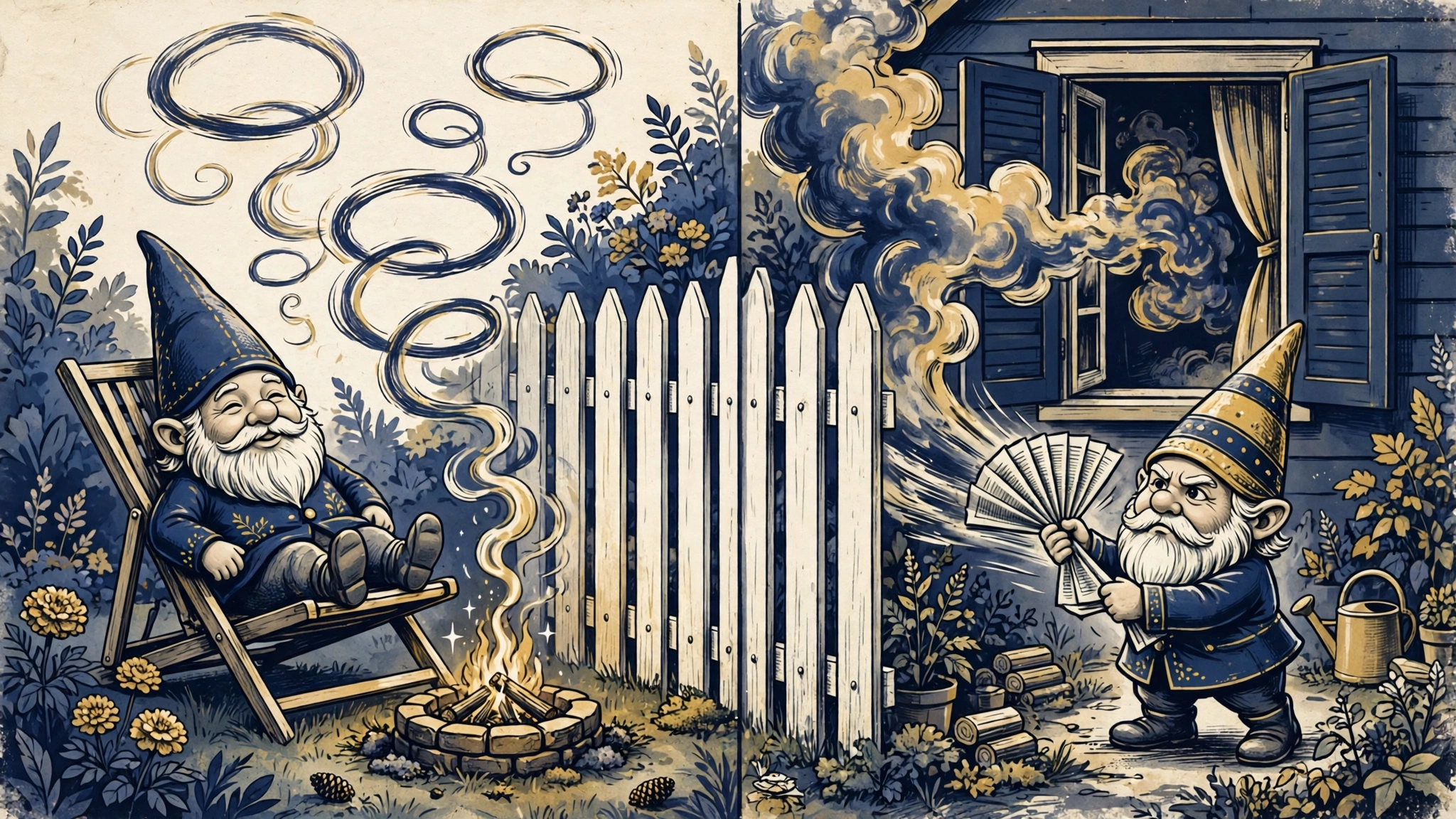
You open the windows on a mild evening. Smoke rolls in from next door. It fills the kitchen and settles in the bedroom. You shut the windows, but the smell stays in the curtains. The next night it happens again. And the next.
The source changes from street to street: cigarettes on a porch, marijuana smoke, or a fire pit most nights. The legal question stays the same: when does drift become more than an annoyance?
The short answer is this. South Carolina has no statewide law that bans a neighbor's cigarette or wood smoke drifting between houses. The claim runs through two other paths: private nuisance law, and the recorded covenants of your community. Both paths turn on facts: how often the smoke comes, how long it lasts, what time it comes, and what use of your home it takes away. Our broader South Carolina HOA and POA homeowner rights guide covers rights across the association. This post stays on smoke between detached houses.
Can smoke from a neighbor really count as a legal problem?
Yes, it can. Smoke moves on air, enters a house without an open door, and can take away the normal use of rooms, a porch, and a yard. South Carolina courts have long treated odor carried on air as the kind of harm nuisance law can address. Smoke is odor carried on air, plus visible drift you can see and note.
That does not mean all drifting smoke wins. A faint smell, a Saturday grill, or a fire pit used now and then will not move a board or a judge. The law protects a real loss of use.
Think of two patterns. In the first, a fire pit lights on a few fall nights, drifts for an hour, then fades. In the second, a neighbor smokes on a side porch all day, day after day, close to your open windows, or a fire pit burns most nights and you must keep bedroom windows shut to sleep. The second pattern is the one the law was written for.
What does South Carolina law call a nuisance?
South Carolina courts use a classic, plain definition. A nuisance is anything which works hurt, inconvenience, or damage, and anything which essentially interferes with the enjoyment of life or property. The Supreme Court of South Carolina stated that definition in Strong v. Winn-Dixie Stores, 240 S.C. 244 (1962), and the Court of Appeals restated it in Neal v. Darby, 282 S.C. 277 (Ct. App. 1984). The words are broad. They cover odor and smoke that make a home hard to live in, even when nothing is broken.
The modern test for a private nuisance comes from Ravan v. Greenville County, 315 S.C. 447, 434 S.E.2d 296 (Ct. App. 1993). A private nuisance is a substantial and unreasonable interference with the use and enjoyment of land. Both words do work. Substantial means real and weighty. Unreasonable means the conduct does not hold up when the rights of both households are weighed side by side.
Ravan also draws a line that helps here. Trespass protects possession of land. Nuisance protects use and enjoyment of land. Drifting smoke rarely takes possession of your lot. It takes use and enjoyment: fresh air in a bedroom, an evening on the porch, the chance to open windows in mild weather. That is nuisance ground.
Reasonableness under Ravan is in most cases a question for the jury. No fixed reading or hour count decides all cases. The fact finder looks at strength, frequency, duration, timing, the neighborhood, and what the family next door has lost.
When does smoke drift cross the line from annoying to unlawful?
The floor under the test comes from Babb v. Lee County Landfill SC, LLC, 405 S.C. 129, 747 S.E.2d 468 (2013). In the court's words, persons must suffer some inconvenience from neighbors for modern life to carry on. Some drift is part of living near other houses. A claim that treats any smell at all as unlawful will fail.
The cases that cross the line share a shape. First, the drift is frequent. It happens many days in a row, or on most nights in a week, not once in a season. Second, it lasts. It hangs in the air and works into the house, and does not pass in five minutes. Third, the timing hurts. Smoke in a bedroom at night, or on a porch at the hour a family eats outside, weighs more than a brief smell at midday when the house sits empty. Fourth, the loss is concrete. Windows must stay shut. A porch or yard goes unused. Sleep is lost. A room must be left.
Health effects belong in the record when they are real and documented by the homeowner. Note the headache, the cough, the date and hour, and a doctor visit if one takes place. Do not stretch the point. Claims beyond what you can show hurt trust.
Notice matters too. A pattern that continues after a calm written notice, with no effort to move the chair, shift the fire pit, or cut the hours, is one a fact finder can call unreasonable.
Is smoke drifting into my house a trespass?
In most smoke cases, no, and Babb explains why. Trespass needs a physical, tangible intrusion. The Babb court held that invisible odors are not a trespass, because odor alone is not that kind of intrusion. Smoke sits close to odor in this analysis. The drift you smell, and the harm it does inside your home, fits nuisance law far better.
Babb left a second door open, with care. A negligence claim based on offensive odors may proceed if all the elements of negligence are proved. That is no shortcut: duty, breach, cause, and damage must each be proved.
This split matters for how you write a complaint. Do not claim trespass each time wind blew smoke across the lot line. Name the interference, how often it happened, how long it lasted, and the use you lost, and quote the covenant words the conduct breaks.
Our general guide to a nuisance neighbor in an HOA and what to do works through the same Ravan test for noise and dogs. Smoke uses that test too. The proof differs: smoke leaves no sound recording, so the written log carries more weight.
What do HOA covenants say about smoke and offensive activity?
Read the recorded covenants before you cite any case. The covenants are the contract that binds the lots, and most South Carolina declarations carry a nuisance or offensive-activity clause that reaches smoke.
Two recorded examples show how direct the language can be. The declaration for Croghan Landing in Charleston County, recorded in Book F317 at Page 844, states in paragraph 34 that no "noxious or offensive activity" shall be carried on upon any lot. The same paragraph bars keeping any plant, animal, device, or thing whose normal activities or existence diminish or destroy other owners' enjoyment. A porch habit that fills the next house with smoke, night after night, is the kind of activity that language aims at.
The declaration for Magnolia Phase 1 at Cane Bay in Berkeley County, recorded in 2012, uses broader words in paragraph 11. It bars anything that "is or may become an annoyance or nuisance to the owners of other Lots." The board need not wait until the harm is at its worst. Conduct that may become a nuisance falls within the clause.
Pull the recorded copy of your own declaration, not a closing packet summary. Quote its paragraph number, and match a dated fact to a phrase in the clause. Also check who can enforce. Many declarations let the association enforce, and many also let an owner enforce if the board will not act.
Does it matter if the smoke is cigarettes, marijuana, or wood smoke?
The source matters less than the drift. Nuisance law does not ask first what was burned. It asks what reached your house, how much, how often, and what use it took away. Cigarette smoke from a porch chair, marijuana smoke with a strong lingering smell, and wood smoke from a fire pit all move on the same air. All three can support a claim when the pattern is substantial and unreasonable. All three can fail when the pattern is light, brief, or rare.
The source does shape the fix. Cigarette smoke from a fixed porch chair points to a fixed cure: move the spot or shift the hours. Wood smoke points to placement and timing: a pit close to the lot line, upwind of a bedroom, and used late is harder to defend than a pit at the back of a deep lot. With marijuana smoke, keep the focus on interference, not approval of the habit.
Do not invent a ban that does not exist. A letter claiming a statewide smoke ban will lose trust when it is checked. A good file rests on the covenant text, the case test, and a dated record.
How do I prove smoke is taking the use of my home?
Smoke proof is built, not gathered in one night. You cannot hand a board a bottle of the smell. You can hand over a steady, dated, plain record that shows the pattern and the loss.
Keep a log. Write the date, start and end times, and the source if you know it. Note which windows were open, which rooms filled, and what you had to do: shut the windows, leave the porch, or move a child to another room. Keep the words flat. A log that reads like a weather record helps more than a diary of anger.
Add what support you can. Short video can show visible drift. A note from another household, with dates, shows this is not a private feud. Save notes that show you raised the problem and what the neighbor said.
Our guide on how to document neighbor harassment covers habits that make a record hold up: date and time on all entries, facts apart from opinions, one file in one place. Do not enter the neighbor's lot for proof, and do not aim a camera into a neighbor's windows.
Bring the log up to date before each step. Three weeks of entries beat two angry paragraphs about one bad night.
What should I do first, and in what order?
Work in order. Each step builds the file the next step needs.
First, give one calm written notice to the neighbor. Name the pattern in dates and hours, name the lost use, and ask for a specific change: move the chair or the fire pit, or cut the late hours. Keep a copy. If it does not work, you hold proof the neighbor knew and the pattern went on.
Second, file a written complaint with the HOA. Quote the nuisance paragraph, attach the log, and state the outcome you want: a violation notice, the hearing your covenants call for, and enforcement until the breach stops. Ask for the decision in writing, and keep logging. Drift through a cure window is strong proof.
Third, check what local rules may apply to the source. Fire pits and open burning are often addressed in town or county rules, and a call made while smoke is heavy can create an official record. Those rules differ by place, so check the code where your house sits. The local record proves the event; the covenant track gives the board its own ground to act.
Fourth, if the pattern holds, move to counsel and a demand on the full file. A board, a mediator, and a judge will all ask what was tried first. A file that shows fair notice and a chance to cure puts you in the strongest place the facts allow.
What can the HOA, a court, or I actually get done about it?
A board that finds a breach can send violation notices, hold the hearing its documents call for, fine where the documents allow fines, and sue to enforce the declaration. Boards move best on a short complaint, a quoted clause, and a three-week log.
In court, a private nuisance claim is actionable for abatement or for damages. That rule comes from Home Sales, Inc. v. City of North Myrtle Beach, 299 S.C. 70 (Ct. App. 1989). Abatement means an injunction, a court order that stops or changes the conduct. For most smoke cases that order is the real goal. It can address the spot, the hours, or the use itself, shaped to stop the interference while leaving the neighbor the lawful use of his lot that does not harm yours.
A hog case gives the closest South Carolina analogy. In O'Cain v. O'Cain, 322 S.C. 551, 473 S.E.2d 460 (Ct. App. 1996), hogs were lawfully raised in a rural area, but placed on a strip right in front of the neighbor's home. Odor and flies took the use of the home and its decks, and hurt marketability, when other land was available. The court found the placement unreasonable and supported an injunction, weighing benefit to the defendant against hardship to the plaintiff. O'Cain is not a smoke case. Its logic fits by analogy: a lawful activity placed so its odor dumps on the next home, when other choices exist, can be unreasonable.
Damages need a plain warning. Under Babb, damages for a temporary nuisance are limited to lost rental value. Damages for a lasting nuisance are limited to the full market value of the property where no restoration costs are claimed. Most smoke cases are about stopping the drift, not a large money award.
Two defenses come up often. The first is, "you moved next to a smoker." Coming to the nuisance is not a bar in South Carolina, under Brooks v. Council of Co-Owners, 314 S.C. 242 (1994). It is one fact in the balance, not the end of the case. The second is, "I have a right to use my lot." You both do, and Ravan weighs both sides.
Frequently asked questions about neighbor smoke in an HOA
Is occasional fire pit smoke enough for a nuisance claim?
On its own, in most cases, no. A pit used now and then, for a short time, with smoke that passes, sits on the side of the line Babb described: some inconvenience must be borne for modern life to carry on. The claim grows when a pit is used most nights, burns late, sits upwind of a bedroom, and forces windows shut for hours. Frequency, duration, timing, and lost use move the case, not the mere fact that wood was burned.
Can the HOA make my neighbor stop smoking on his own porch?
The HOA can enforce its covenants, and a nuisance clause can reach a porch habit that fills the next house with smoke. What the board can order depends on the words of your declaration and its process. The board enforces the contract; no statewide smoke ban covers this drift. Give the board the clause, the log, and the cure you seek, and ask for its decision in writing.
What if I bought my house knowing the neighbor smoked?
That fact does not end your claim. Under Brooks, coming to the nuisance is not a bar in South Carolina, though what you knew can be argued as one part of the balance. The stronger parts of your file are what happened after: how often the drift comes, what use it takes, what notice you gave, and what low-cost changes were refused.
When should I call a lawyer about drifting smoke?
Call when the ladder has been climbed and the smoke still rolls in. Call sooner when health effects are documented and ongoing, when the neighbor answers a calm notice with threats, when a sale is at risk, or when the board has closed your complaint in writing and the pattern has not changed. The question then is whether your file meets the Ravan test and the words of your covenants, and what remedy fits: a demand, mediation, a covenant suit, a nuisance suit, or a mix of those paths.
Bring the file: the declaration with the nuisance paragraph marked, the log, the notice to the neighbor, the HOA complaint, the board's reply, and health notes tied to dated events. Counsel can tell you in one review where you stand.
Traywick Law represents South Carolina homeowners in HOA and neighbor disputes. If smoke is taking the use of your home and the early steps have not worked, send a free consultation request and describe the pattern in dates, hours, and rooms affected.
This post gives general legal information about South Carolina law. It is not legal advice about your facts, and reading it does not create an attorney-client relationship. Covenants and local codes differ from community to community and town to town. Talk with a South Carolina lawyer about your situation before you act.