Overwhelmed by Credit Card Debt? How Traywick Law Offices Can Help You Understand Your Options
If you are struggling with credit card debt in South Carolina, Traywick Law Offices can help you evaluate the problem from a legal perspective and determine what options may be available before the situation gets worse.
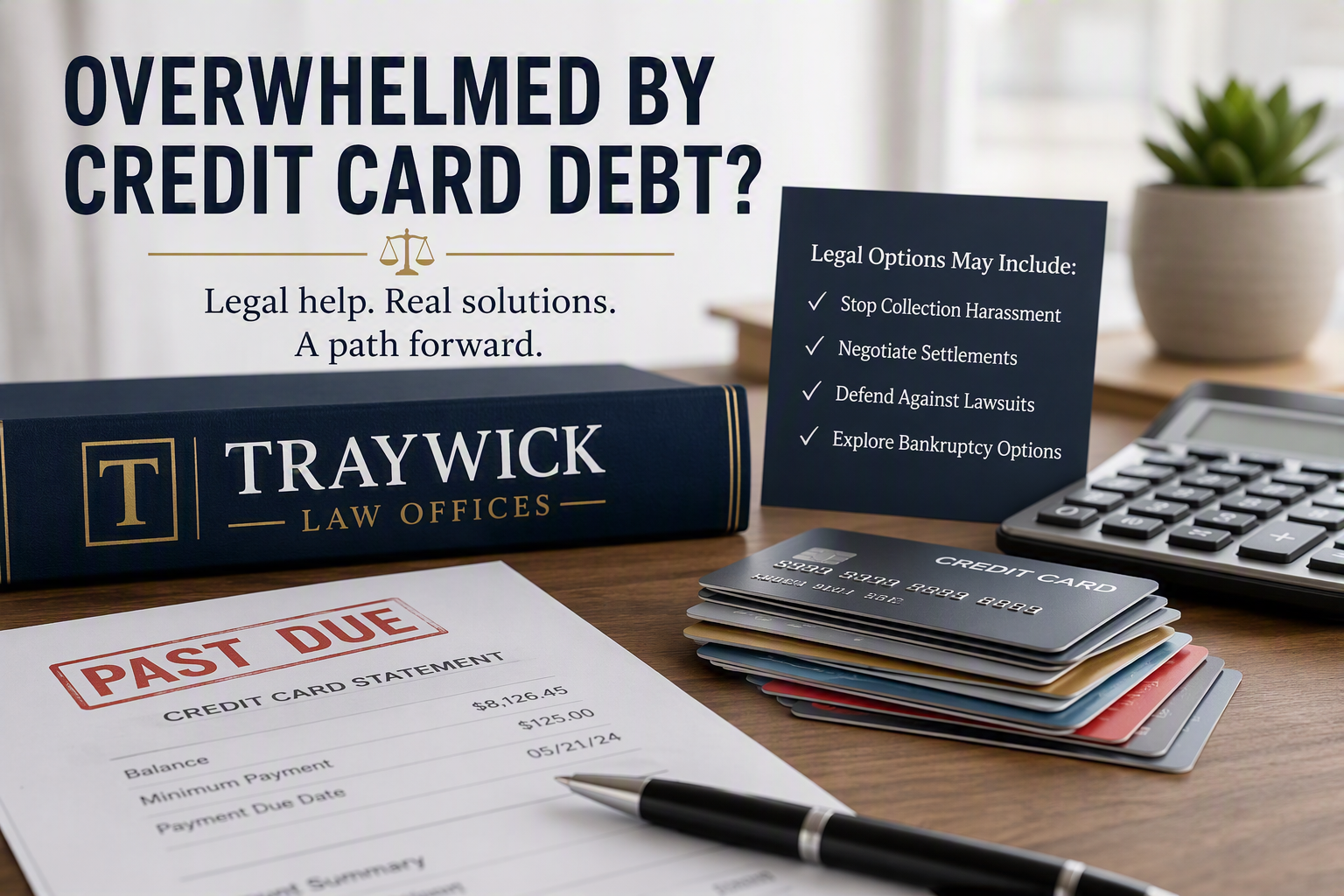
Credit card debt can become overwhelming faster than many people expect.
High interest rates, minimum monthly payments, late fees, unexpected medical expenses, reduced income, divorce, job loss, or simply relying on credit cards to cover ordinary living expenses can leave a borrower with balances that no longer seem manageable.
If you are struggling with credit card debt in South Carolina, Traywick Law Offices can help you evaluate the problem from a legal perspective and determine what options may be available before the situation gets worse.
Being overextended does not necessarily mean you should immediately file bankruptcy, stop paying your creditors, or sign up with a debt settlement company. The first step should be understanding precisely what you owe, the status of each account, and the legal consequences of the alternatives available to you.
Are You Overextended on Credit Cards?
Warning signs may include:
- Using one credit card to make payments on another debt
- Making minimum payments without significantly reducing principal
- Regularly using credit cards for groceries, utilities, or other necessities because your income is already committed
- Falling behind on one card while trying to keep others current
- Receiving collection letters or telephone calls
- Having an account charged off or transferred to a collection agency
- Being sued by a credit card company or debt buyer
- Considering withdrawing retirement funds or borrowing against property to pay unsecured credit card debt
At that point, it may be worthwhile to step back and examine your overall financial position rather than simply trying to make the next minimum payment.
We Can Help Analyze Your Credit Card Debt
One of the most important things an attorney can do is help the borrower understand the entire debt picture.
At Traywick Law Offices, we can review the facts surrounding your accounts, including balances, account statements, collection correspondence, lawsuits, credit reports, available income, and other obligations.
The objective is to identify which debts require immediate attention and which options deserve further consideration.
This is particularly important when an account has already been turned over to a third-party debt collector. Federal law provides consumers with protections concerning debt collection practices, including restrictions on abusive, unfair, and deceptive conduct. The Federal Trade Commission confirms that the Fair Debt Collection Practices Act provides protections involving consumer credit-card debt. [consumer.ftc.gov]
The Consumer Financial Protection Bureau also provides consumers with information concerning validation of debts, communications with collectors, responding to collection activity, negotiating settlements, and responding when a creditor or collector files a lawsuit. [consumerfinance.gov]
Negotiating and Settling Credit Card Debt
Depending upon the facts, settlement may be one option worth investigating.
A lawyer can help evaluate the documentation, the creditor or collector involved, the status of the account, and any pending litigation before determining whether attempting a negotiated resolution makes sense.
Settlement should not simply be about obtaining the lowest number someone will offer over the telephone.
The terms matter.
A borrower should understand what the settlement resolves, when payment is required, what happens to any remaining balance, and whether there may be other consequences arising from the transaction.
We can help clients evaluate proposed settlement terms and determine whether an agreement actually accomplishes what the borrower believes it does.
What If You Have Been Sued Over a Credit Card?
Ignoring a credit card lawsuit can create additional problems.
The CFPB specifically advises consumers who do not believe they owe a debt to tell the collector rather than simply avoiding the collector, and it provides resources addressing situations in which a creditor or debt collector files suit. [consumerfinance.gov]
At Traywick Law Offices, we can review a credit card lawsuit, the underlying account, and the documentation supporting the creditor's claim and advise you regarding available legal options.
The mere fact that someone has received a summons and complaint does not mean the person should assume there is nothing left to discuss or evaluate.
Dealing With Debt Collectors
Consumers also have legal rights regarding the manner in which certain debt collectors pursue debts.
The FTC states that the FDCPA prohibits debt collectors from using abusive, unfair, or deceptive practices to collect covered consumer debts. The FTC also explains that collectors generally must provide consumers with validation information concerning the debt and describes restrictions on the times and methods by which covered collectors may communicate with consumers. [consumer.ftc.gov]
If you are receiving collection communications that you believe are improper, keep the evidence.
Save:
- Letters and collection notices
- Emails and text messages
- Voicemails
- Account statements
- Lawsuit papers
- Settlement proposals
- Payment records
- Screenshots of relevant communications
Those materials can help an attorney understand what occurred and determine what legal issues should be investigated.
Should You Use Savings or Retirement Money to Pay Credit Card Debt?
This deserves careful consideration.
Someone carrying substantial credit card balances may understandably want to make the problem disappear by withdrawing money from an IRA, exhausting savings, borrowing against a home, or selling an asset.
But converting protected or strategically important assets into cash to satisfy unsecured debt can have significant financial, tax, and legal consequences.
Before making an irreversible financial move, we can help examine the debt problem as a whole and identify the legal considerations that should be evaluated. Tax and investment consequences should also be reviewed with appropriately qualified tax or financial professionals where necessary.
What About Bankruptcy?
Bankruptcy may be appropriate for some borrowers and inappropriate for others.
The important point is not to assume that bankruptcy is either your first choice or something that must be avoided at all costs.
The proper approach depends upon the individual's debts, assets, income, pending collection activity, lawsuits, and other circumstances.
Our goal is to help a client understand the available alternatives so that an informed decision can be made.
Don't Wait Until Every Account Is in Collection
One of the biggest mistakes an overextended borrower can make is waiting until the financial problem has become a legal emergency.
If you can see that your credit card balances are becoming unsustainable, it may make sense to obtain legal advice before multiple accounts are charged off or lawsuits are filed.
The earlier you understand your position, the more informed your decisions can be.
Talk to Traywick Law Offices About Your Credit Card Debt
If you live in South Carolina and are overwhelmed by credit card balances, collection demands, or a credit card lawsuit, Traywick Law Offices can help you evaluate your situation and understand the legal options that may be available to you.
You do not have to make major financial decisions based solely on collection calls, internet advertisements, or fear about what may happen next.
Traywick Law OfficesMount Pleasant, South Carolina
David P. Traywick, Attorney
📞 tel:+18433435092
✉️ dpt@traywicklaw.com