Water Intrusion in Your South Carolina Condo? How Building-Envelope Defects and Mold Become Multi-Million-Dollar Cases
A brown stain spreads along your window frame. The drywall feels soft. Behind it: soaked sheathing, rotted framing, black mold. In South Carolina condos and townhomes, this is the signature failure — water breaching the building envelope through bad flashing, failed stucco, and defective window installation, then destroying the structure unseen for years. Here is how these defects happen, who is liable, what the law gives owners and associations, and what to do the moment you spot the first sign.
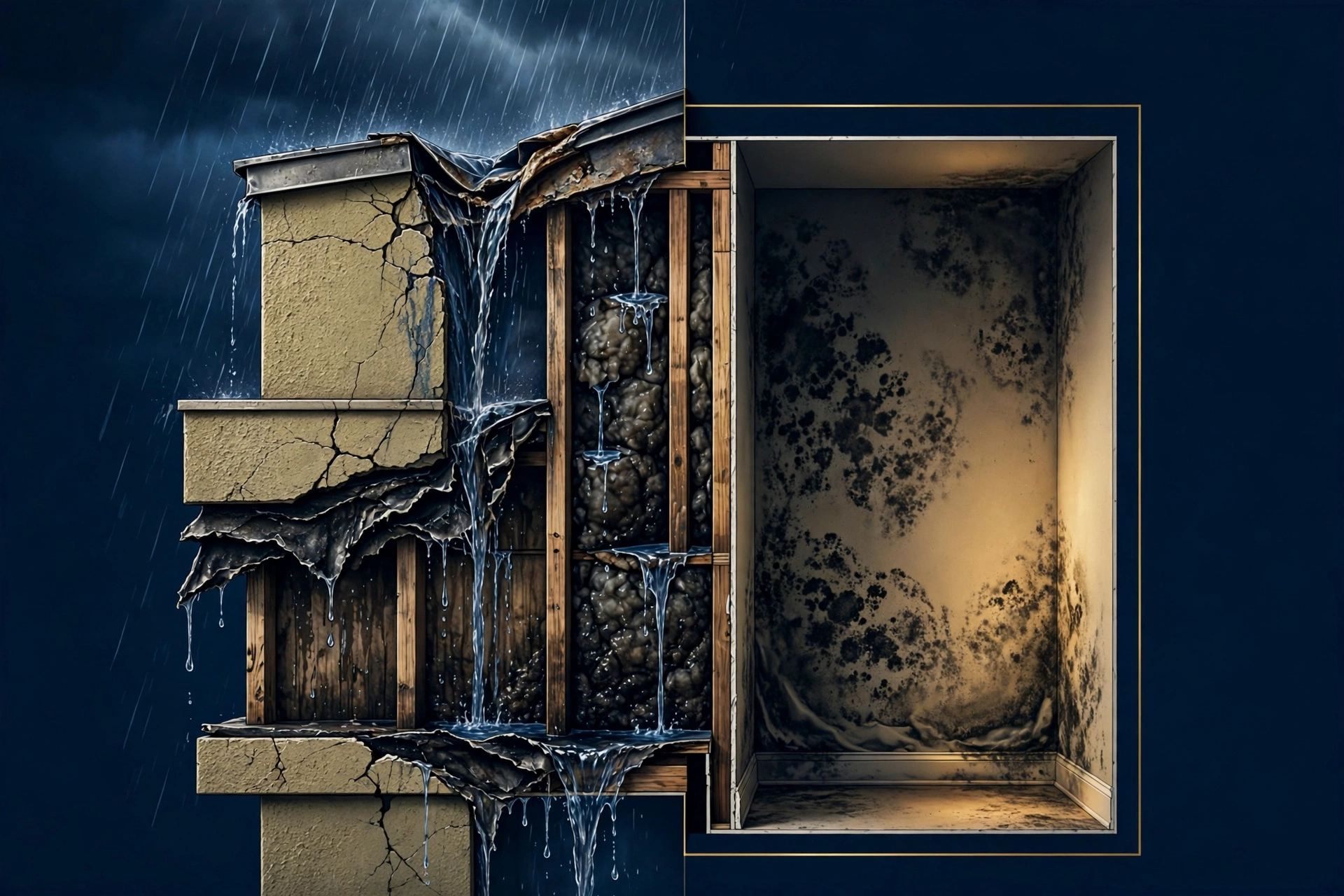
It starts small. A tea-colored stain creeps along the top of a window frame. A musty smell you cannot place. A patch of drywall that gives a little when you press it.
Behind that wall, the story is bigger: rainwater that has been entering the building for years, soaking the sheathing, rotting the framing, feeding mold colonies across entire wall cavities. In coastal South Carolina — Charleston, Mount Pleasant, Johns Island, Hilton Head, Myrtle Beach — this is the defect cluster that produces the largest condo cases in the state. Water intrusion through a failed building envelope, concealed until the damage is structural.
If you own a condo or townhome and you are seeing the early signs, this post explains what is happening inside your walls, who is legally responsible, and what you and your association should do right now.
How Water Gets Into a South Carolina Condo: Bad Flashing, Failed Stucco, Defective Windows, and Roof Failures
A building envelope is the system that keeps weather out: cladding, flashing, sealants, windows, doors, and the roof, working together to shed water and let any water that does get in drain back out. In South Carolina condo construction, the envelope fails at predictable points.
Flashing failures. Flashing is the metal or membrane material installed at every transition — where the roof meets a wall, around windows and doors, at decks and balconies — to direct water outward. When flashing is missing, installed backward, or butted without proper laps, water runs behind the cladding instead of away from it. Forensic studies of failed Lowcountry buildings routinely find missing head flashing above windows and improper flashing at deck-to-wall intersections across entire complexes.
Stucco and EIFS failures. Traditional cement stucco and synthetic stucco (EIFS — Exterior Insulation and Finish System) are common on South Carolina condos. Both fail when installed wrong. Barrier-type EIFS, widely used in the 1990s and 2000s, traps water that gets behind it because the system does not drain; the water sits against the sheathing and rots it. Even drainable stucco systems fail when installers skip the drainage plane, omit weep screeds, or seal joints with caulk that cracks within a few seasons. The damage hides behind an exterior that can look perfectly fine from the parking lot.
Window and door installation defects. Windows are holes cut in the envelope, and every one is a potential leak. Common defects: windows set without sill pan flashing, housewrap lapped the wrong direction so it channels water inward, and sealant-only joints where the building code requires flashing. The first visible symptom in many South Carolina condo cases is water staining along window frames — the tell that water has been entering around the opening for a long time.
Roof and drainage failures. Improperly detailed roof-to-wall transitions, clogged or undersized gutters, and site drainage that ponds water against foundations all feed intrusion. On multi-building condo developments, a single repeated design error — one bad flashing detail copied across twelve buildings — multiplies the damage across every unit.
South Carolina's climate accelerates everything. Driving coastal rain, hurricane-season downpours, high humidity, and salt air punish every weak detail. A marginal flashing job that might survive decades inland fails in years on the coast.
Why Water Intrusion Goes Unnoticed for Years Behind the Walls
Water intrusion is a latent defect: hidden by its nature. The exterior cladding looks intact. Interior drywall shows nothing until the damage is advanced. Years can pass between the first drop of water entering a wall cavity and the first stain appearing inside a unit.
Several things conspire to keep it hidden. Stucco and EIFS exteriors conceal everything behind them — owners at one Johns Island condo complex later said the buildings "looked great" from the parking lot while wood rot festered behind the stucco. Paint and caulk mask early deterioration. And the damage progresses slowly: sheathing swells, fasteners corrode, framing softens, mold colonizes — all inside a sealed cavity no one opens.
This latency is exactly why these cases become large. By the time an owner notices staining or smell, the defect has often affected dozens of units and the repair scope involves stripping cladding from entire elevations, replacing structural framing, and remediating mold building-wide. The repair number climbs into the millions while nobody was watching.
It is also why the statute of limitations rarely starts at construction. South Carolina's general three-year limitations period for these claims typically runs from when the owner knew or should have known of the defect — and a defect sealed inside a wall is not something an owner should have known about until it shows itself. (Timing rules have sharp edges, including an eight-year statute of repose discussed below. Get counsel on deadlines early.)
Mold, Rot, and Structural Damage: What Water Does Inside the Building Envelope
Once water is inside the wall, the damage compounds:
- Wood rot. Sheathing, studs, sill plates, and rim joists stay wet and decay. Structural framing loses strength. In advanced cases, entire wall sections must be reframed.
- Mold. Mold colonizes damp drywall, insulation, and wood within days of sustained moisture. Behind-cladding mold spreads across whole elevations. Remediation means removing all affected material under containment — not painting over it.
- Fastener and connector corrosion. Nails, screws, and hurricane ties corrode in persistent moisture, degrading the structural connections that hold the building together in high winds.
- Interior damage. Stained and softened drywall, ruined flooring, damaged cabinetry, and destroyed insulation in every affected unit.
- Diminished value and marketability. This one hits before any repair starts. Freddie Mac classifies "mold, water intrusions or potentially damaging leaks" as material deficiencies: a condo building suffering water intrusion is not eligible for Freddie Mac mortgage purchases until the problems are repaired. When buyers cannot get conventional financing, units do not sell, values fall, and owners are trapped.
The health dimension matters too. Persistent indoor mold exposure is associated with respiratory and allergy problems, and families with children, elderly residents, or immunocompromised members feel it first. Document any health complaints alongside the physical damage.
The Building-Envelope Study: How Experts Prove a Water-Intrusion Case
Water-intrusion cases are won with expert evidence, not opinions. The centerpiece is the building-envelope study — a forensic investigation by a licensed architect or engineer experienced in moisture intrusion.
A proper study follows a sequence. The expert reviews the original plans, specifications, and product data to learn what was supposed to be built. Then comes field investigation: visual survey of every elevation, moisture-meter readings across walls, infrared thermography to map wet areas, and — critically — test cuts: small, controlled openings in the cladding and sheathing at representative locations to see the actual condition of the framing, flashing, and weather barriers behind. Water testing (controlled spray at windows and transitions) can confirm active leak paths.
The study produces what the case needs: the specific defects (missing flashing at window heads, stucco without drainage, reversed housewrap laps), the building-code and manufacturer-installation standards each defect violates, the scope of resulting damage, and the cost to repair. That repair number — developed by the expert, not guessed at — becomes the damages model.
Two practical warnings. First, use an independent expert, not anyone connected to the builder or developer. Second, preserve the evidence: photograph everything, keep samples of rotted material, and do not let well-meaning maintenance crews tear out and discard damaged assemblies before the expert documents them. Destroyed evidence is a destroyed claim.
In one well-known South Carolina case, the owners' association had to get a court order just to allow a forensic investigator to make test cuts in the exterior walls — because the developer still controlled the association. If anyone is blocking investigation access, that itself is a signal to get a lawyer involved immediately.
Who Is Liable for Condo Water Intrusion in South Carolina?
Water-intrusion liability spreads across everyone who touched the building:
- The developer/declarant. The developer chose the design, hired the builder, and sold the units — often with marketing promises about quality. Developers also frequently control the owners' association during the sellout period, which can delay discovery and action.
- The general contractor. Responsible for the overall construction, including means and methods, sequencing, and supervision of trades. Systemic flashing and stucco failures across multiple buildings point at the GC.
- Subcontractors. The stucco applicator, the window installer, the roofer, the framer — each owns its scope. In the Twelve Oaks at Fenwick Plantation litigation on Johns Island, the stucco subcontractor alone faced trial over defectively installed stucco across the complex — with a $7.723 million verdict entered against it.
- The architect and design professionals. Liable for defective design: details that could never work, missing flashing details in the drawings, specifications that do not comply with code. Engineers who certified the work can face exposure too.
- Material suppliers and manufacturers. When a product itself fails — or when installation instructions were inadequate — product claims enter the picture.
South Carolina law reaches all of them. Negligence, breach of contract, breach of warranty, and the implied warranty of habitability (discussed below) give owners multiple paths, and defendants then fight among themselves over indemnity and who caused what. That finger-pointing is normal and useful: it tends to produce settlements.
Individual Unit Claims vs. Common-Element Claims: Who Sues Whom
In a condo regime, the building envelope — exterior walls, roofs, windows, flashing, structural framing — is typically a common element: owned collectively, maintained by the association. That distinction drives the structure of the case.
The association sues for common-element defects. The HOA or regime acts for all owners to recover the cost of repairing the envelope itself: re-cladding elevations, replacing rotted structural framing, remediating common-area mold. This is where the big dollars live, because envelope repairs are building-wide by nature.
Individual owners sue for unit damage. When intrusion damages the inside of a unit — drywall, flooring, cabinets, personal property, mold-related health costs, loss of use — the affected owner has individual claims. Individual claims can also cover diminution in the unit's value.
They usually proceed together. In the Twelve Oaks litigation, individual homeowners and the property owners' association filed related suits that were consolidated — the owners pursuing unit-level harm, the association pursuing the common building defects, all against the web of contractors and subcontractors. Coordinated representation avoids conflicting strategies and splits costs.
If your association's board is dragging its feet — especially if the developer still controls the board — individual owners are not powerless. Document the defects, demand action in writing, and consult counsel about direct claims and about forcing the association to act.
What South Carolina Law Gives Condo Owners: Implied Warranty, Notice-and-Cure, and Deadlines
Implied warranty of habitability. South Carolina law implies into the sale of a new home, townhome, or condo a warranty that the dwelling is suitable for habitation and built in a workmanlike manner — regardless of what the builder's written warranty says, unless the buyer specifically bargained over warranty terms. Builders routinely hand buyers a limited 1-2-10 warranty (one year everything, two years systems, ten years structure) and imply that is the whole obligation. It is not. The implied warranty stands behind the paper warranty, and builders sometimes try to waive it in the sales contract — the enforceability of those waivers is itself contested ground. In Damico v. Lennar Carolinas, LLC, 437 S.C. 596, 879 S.E.2d 746 (2022), the South Carolina Supreme Court treated a boilerplate implied-warranty waiver (supposedly bargained-for consideration of $0) as "grossly oppressive." Do not let a builder's "your warranty expired" letter end the conversation.
Notice and opportunity to cure. Before filing suit, South Carolina's Notice and Opportunity to Cure Construction Dwelling Defects Act (S.C. Code §§ 40-59-810 et seq.) requires the claimant to serve the contractor written notice of the defects at least 90 days before filing suit (§ 40-59-840(A)); the contractor then has 30 days to inspect, offer to repair, offer settlement, or deny, and silence counts as denial (§ 40-59-850(A)). Warning: the Act contains no tolling provision, so the 90-day notice period runs against your limitations and repose deadlines — calendar both before sending notice. It applies to qualifying residential construction — single-family homes, duplexes, and multifamily/condo buildings of no more than 16 units and 3 stories (§ 40-59-820(4)) — not large condo towers. The requirements are technical and the deadlines unforgiving, so the notice should be drafted by counsel.
Statute of repose: eight years. S.C. Code § 15-3-640 bars actions arising from a defective improvement to real property more than eight years after substantial completion — an absolute outer wall, regardless of when the defect was discovered. For latent water intrusion discovered in year seven, this deadline is an emergency. (Parties can contractually extend it, and building permits must carry notice of that right, but few buyers know to ask.)
Three-year limitations period. The general limitations period for these claims is three years, typically running from discovery — when the owner knew or should have known of the defect. Between the discovery rule, the 90-day notice-and-cure period that runs against your deadlines (the Act provides no tolling), and the eight-year repose wall, deadline analysis in a water-intrusion case is genuinely complex. The single most expensive mistake an association can make is waiting to investigate.
Known Defects Must Be Disclosed to Buyers: South Carolina's Property Condition Disclosure Law
Water intrusion does not only create claims against builders. It creates claims against sellers who hide it.
South Carolina's Residential Property Condition Disclosure Act (Title 27, Chapter 50) requires sellers of residential property to give buyers a standardized disclosure statement covering the property's condition — including water intrusion, leaks, mold, and structural problems — based on the seller's "actual knowledge" (S.C. Code § 27-50-40(A)). The standard is what the seller genuinely knows, not what an inspection would have found. And the Act authorizes suits against owners who knowingly misstate or conceal material defects (§ 27-50-65).
This matters in condo defect scenarios constantly. A unit owner who watched maintenance patch the same window leak three times, then checks "no" on water intrusion when selling, has created a fraud claim for the buyer. A developer selling converted units while sitting on reports of envelope failure has a bigger problem. And associations should know: when the regime knows the buildings leak and stays silent while units change hands, the disclosure exposure spreads.
If you bought a condo and discovered the seller knew about water problems — prior leak repairs, mold remediation, engineering reports, insurance claims — preserve the disclosure statement from your closing package. It is exhibit one.
What to Do the Moment You See Staining, Smell Mustiness, or Find Soft Drywall
Act in this order:
- Document. Photograph and video every stain, every soft spot, every visible mold patch, with dates. Keep a written log of when you first noticed each symptom and anything the association or a prior owner told you about leaks.
- Notify in writing. Report it to the association or property manager in writing — email counts — and keep a copy. Verbal complaints evaporate. If you are on the board, put it in the meeting minutes.
- Do not authorize destructive investigation without counsel. Test cuts and invasive moisture surveys are evidence-generating events. Done wrong, they destroy the proof or give the defense an argument. Done right, through an independent expert, they build the case.
- Get an independent building-envelope expert. Not the builder's engineer. A licensed architect or engineer with forensic moisture-intrusion experience, engaged through counsel so the work product is protected.
- Watch the calendar. Note the building's age against the eight-year repose wall, and calendar the notice-and-cure deadlines. Delay is the defense's best friend.
- Talk to owners in other units. Water intrusion is almost never isolated. If your window leaks, the identical detail exists on every unit. A multi-unit pattern turns an individual repair bill into an association-level case with the economics to fund real litigation — and it protects you from paying a special assessment for damage the builder caused.
- Call a construction-defect lawyer before you sign anything. Do not sign releases, accept the builder's "courtesy repair," or agree to the developer's preferred contractor touching the building until counsel reviews the situation. A quick patch that masks the defect can cost you the claim.
I Bring Water-Intrusion and Mold Defect Claims for Condo Owners and Associations
This is the work. I represent South Carolina condo owners and owners' associations in building-envelope failure cases — water intrusion, mold, rot, and structural damage caused by defective construction.
What that means in practice: I engage the independent forensic experts who prove what failed and what it costs to fix. I identify every liable party — developer, general contractor, subcontractors, architects — and pursue each. I handle the South Carolina notice-and-opportunity-to-cure process so the claim is not thrown out on a technicality. I coordinate association-level common-element claims with individual owners' unit-damage claims so nothing is left on the table. And I build cases sized for the actual economics: multi-unit, building-wide, expert-driven — the kind of case where the repair number justifies the fight.
The pattern in these cases never changes: the buildings looked fine, the damage was hidden, and by the time anyone acted the repair cost had multiplied. The owners who recover are the ones who investigated early and hired counsel before the deadlines closed.
If your condo or townhome shows staining, mustiness, soft drywall, or visible mold — or if your association suspects the buildings are leaking behind the cladding — get a free consultation. The earlier the investigation starts, the larger the recovery and the smaller the repair.
This post is for general information about South Carolina construction-defect law. It is not legal advice about your building. Deadlines in defect cases are strict and fact-specific — talk to a lawyer about yours.