Credit Card Delinquency Near Great Recession Levels: What the NY Fed Data Means for South Carolina Consumers
A viral chart shows credit card delinquency near 13% — almost as bad as 2010. The New York Fed confirms the number is real, but its own economists say the headline needs context. Here is what the data actually shows, who is falling behind, and what to do if you can't pay your credit cards in South Carolina.
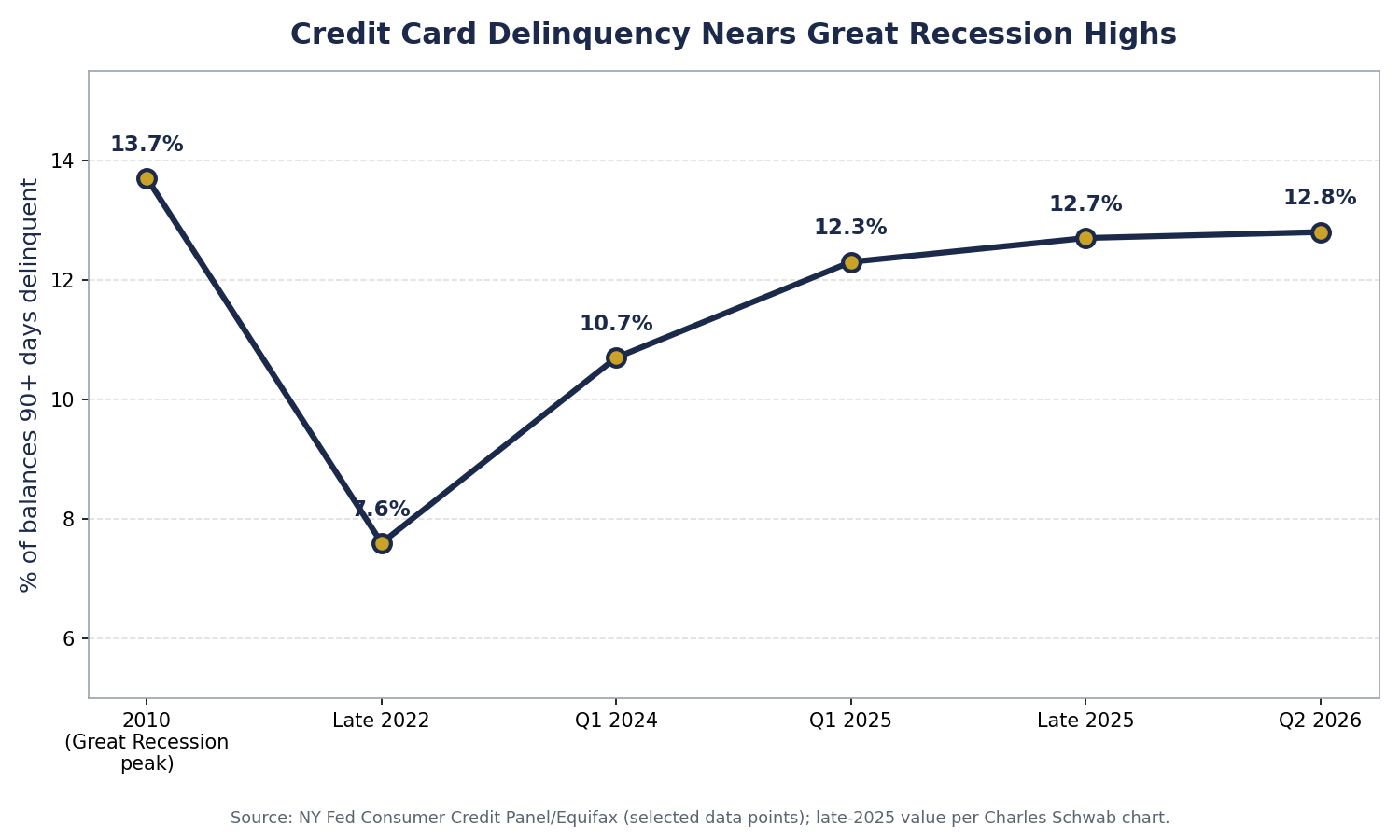
A chart has been making the rounds on financial media: the share of credit card balances 90 or more days past due, climbing steeply toward 13% — a level not seen since the aftermath of the 2008 financial crisis. The chart comes from Charles Schwab, built on data from the New York Fed's Consumer Credit Panel/Equifax, current through December 31, 2025.
Is it real? Yes. The Federal Reserve Bank of New York's own numbers back it up. But the Fed's economists also say the scary headline needs context — and that context matters, because it tells you exactly who is in trouble and what actually helps.
If you are one of the millions of Americans falling behind on credit cards, the national debate is beside the point. What matters is what happens next to you — and what you can do about it right now.
The Viral Chart: Credit Card Delinquency Near 13%
Here is what the data shows. The share of credit card balances 90+ days delinquent:
- Early 2010 (Great Recession peak): 13.7%
- Late 2022: 7.6%
- Q1 2024: 10.7%
- Q1 2025: 12.3%
- Q2 2026: 12.8%
Total credit card balances hit $1.26 trillion in the second quarter of 2026, up $21 billion in a single quarter, according to the New York Fed's Quarterly Report on Household Debt and Credit released August 11, 2026. Total U.S. household debt stands at $18.8 trillion.
Read that trend line again: delinquency has nearly doubled in under four years. That is not a blip.
Stock vs. Flow: What the New York Fed Says the Number Really Means
Here is where honesty matters. The New York Fed published a companion analysis the same day as its quarterly report, and its own economists took the headline number apart.
There are two ways to measure delinquency:
- The "stock" measure — the one in the viral chart — counts every delinquent dollar still sitting on a credit report. That includes old, already-charged-off debts that lenders keep reporting for years.
- The "flow" measure counts how much debt newly goes bad each quarter. This is the read on how households are doing right now.
The flow has been roughly flat since 2024 — 6.93% a year ago versus 6.97% now. That is noise, not acceleration.
So why is the stock number climbing? Partly because previously delinquent accounts are taking longer to resolve — old bad debt lingers on reports longer than it used to. The chart is real, but it is not showing a fresh wave of defaults sweeping the country.
What it is showing: a growing pile of unresolved distress, concentrated in specific households. New York Fed economist Joelle Scally put it plainly: new delinquencies for auto loans and credit cards "remain at elevated levels."
Translation: the crisis is not everywhere. It is somewhere specific — and if you are reading this because you can't pay your credit cards, it may be at your kitchen table.
Who Is Falling Behind on Credit Cards: Young Borrowers, Seniors, and Stretched Families
The pain is not evenly spread. The New York Fed's age breakdown for Q2 2026 is striking:
- Borrowers 18 to 29: the rate of serious delinquency hit 10.1% — more than double the rate from five years ago.
- Borrowers 70 and older: serious delinquency reached 6.3%, the highest since 2011.
- Borrowers 50 to 59: climbed to 6.4%, the highest since late 2024.
Meanwhile, the share of consumers struggling to pay credit cards jumped from about 5% in 2023 to nearly 7% by mid-2026 — a much sharper increase than for auto loans (3%) or mortgages (about 1.5%).
The pattern is a K-shaped consumer: prime borrowers with cushion are fine. Subprime and lower-income households, young adults, and retirees on fixed incomes are getting crushed. One in three workers in retirement plans now carries more credit card debt than retirement savings, according to a 2026 Schroders survey.
If that describes you, you are not irresponsible. You are the demographic the data says is drowning.
The 22% APR Trap: Why Minimum Payments Stop Working
Here is the math that turns a rough patch into a permanent trap. The Federal Reserve's consumer credit data shows the average APR on credit cards actually accruing interest hit 22.15% in Q2 2026. New card offers average 23.82%.
At 22% interest, a $7,000 balance making only minimum payments can take the better part of a decade to clear — and cost nearly as much in interest as the original balance. Every month you can only afford the minimum, the balance barely moves. Miss a payment and the late fees stack on top.
This is the minimum payment trap: the card company designed the minimum to keep you paying interest, not to get you out of debt. When an unexpected expense hits — a car repair, a medical bill, a gap between jobs — the balance jumps and the minimum follows, and suddenly the payment you could barely afford is one you can't.
What Happens If You Can't Pay Your Credit Cards
So what actually happens when you stop paying? In order:
- Late fees and penalty interest. After 60 days late, the card company can jack your rate to a penalty APR.
- Collections calls begin. First from the card company, then from third-party collectors if the debt is sold.
- Charge-off (around 180 days). The lender writes the debt off its books and reports it as a charge-off — devastating to your credit score.
- Sale to a debt buyer. Charged-off debts are routinely sold for pennies on the dollar to buyers who try to collect the full amount.
- Lawsuit. Creditors and debt buyers sue. If you don't respond, they get a default judgment — which in South Carolina gives them collection tools against your bank accounts and property, even though wage garnishment is barred for most consumer debts.
None of this happens overnight. But none of it fixes itself, either. And every stage you ignore narrows your options.
Charged Off Doesn't Mean It's Gone: Collections and Lawsuits
The most dangerous myth in consumer debt: "they charged it off, so it's over." A charge-off is an accounting entry, not forgiveness. The debt still exists, it still sits on your credit report, and someone still owns the right to collect it.
This is also where your rights kick in. Debt buyers who sue on old credit card debt don't always have the paperwork to prove they own your account — and in my practice, that matters. Collectors who harass, lie, or threaten you may be violating federal law, and those violations can become leverage: you may be able to turn their misconduct into a claim of your own. If collectors are calling, read about debt collector harassment and your rights.
Wrong information on your credit report after a charge-off or collection — balances that never update, debts that aren't yours, zombie accounts that keep reappearing — may also violate the Fair Credit Reporting Act. See credit reporting errors.
And if you've already been sued by a creditor, do not ignore the lawsuit. A default judgment is the worst outcome — it hands the creditor everything without a fight.
Can't Pay Credit Cards? Your Options in South Carolina
You have more options than the card companies want you to believe:
- Hardship programs. Most major issuers have internal hardship programs — reduced rates, waived fees, fixed payoff plans — but they don't advertise them. You have to ask, and you have to ask the right department.
- Negotiate a reduced payoff. Creditors and especially debt buyers will often settle for significantly less than the full balance as a lump sum. I negotiate a reduced payoff for clients regularly — what they'll accept depends on the age of the debt, who holds it, and your financial picture.
- Challenge the debt. When you're sued, the collector has to prove its case. Sloppy paperwork, missing chain of title, and time-barred claims are real defenses.
- Counterattack on violations. Collectors who break the rules — calling at all hours, threatening arrest, discussing your debt with others — may owe you money under the FDCPA.
What doesn't work: waiting and hoping. Interest compounds whether you look at the statement or not.
Talk to a South Carolina Debt Relief Lawyer
The national numbers tell a story, but your situation is specific — your balances, your income, who's collecting, and whether they've sued yet. That is exactly what a consultation sorts out.
If you're falling behind on credit cards, getting collection calls, or you've been sued over a debt in South Carolina, call Traywick Law at (843) 343-5092. I'll look at what you're facing and tell you straight what your options are — including whether I can create leverage you don't have on your own. The sooner you call, the more options you have.