Can Your HOA Sue the Developer for Construction Defects in South Carolina?
The roofs leak, the roads are crumbling, the drainage does not drain — and the bill to fix it all lands on the HOA. If the developer built your community's common areas wrong, your association may have the right to make the developer pay. Here is how South Carolina HOAs sue developers for construction defects: who controls the board, what counts as a common element, which warranties apply, how transition works, what happens when reserves were left underfunded, and the deadlines that can kill your claim.
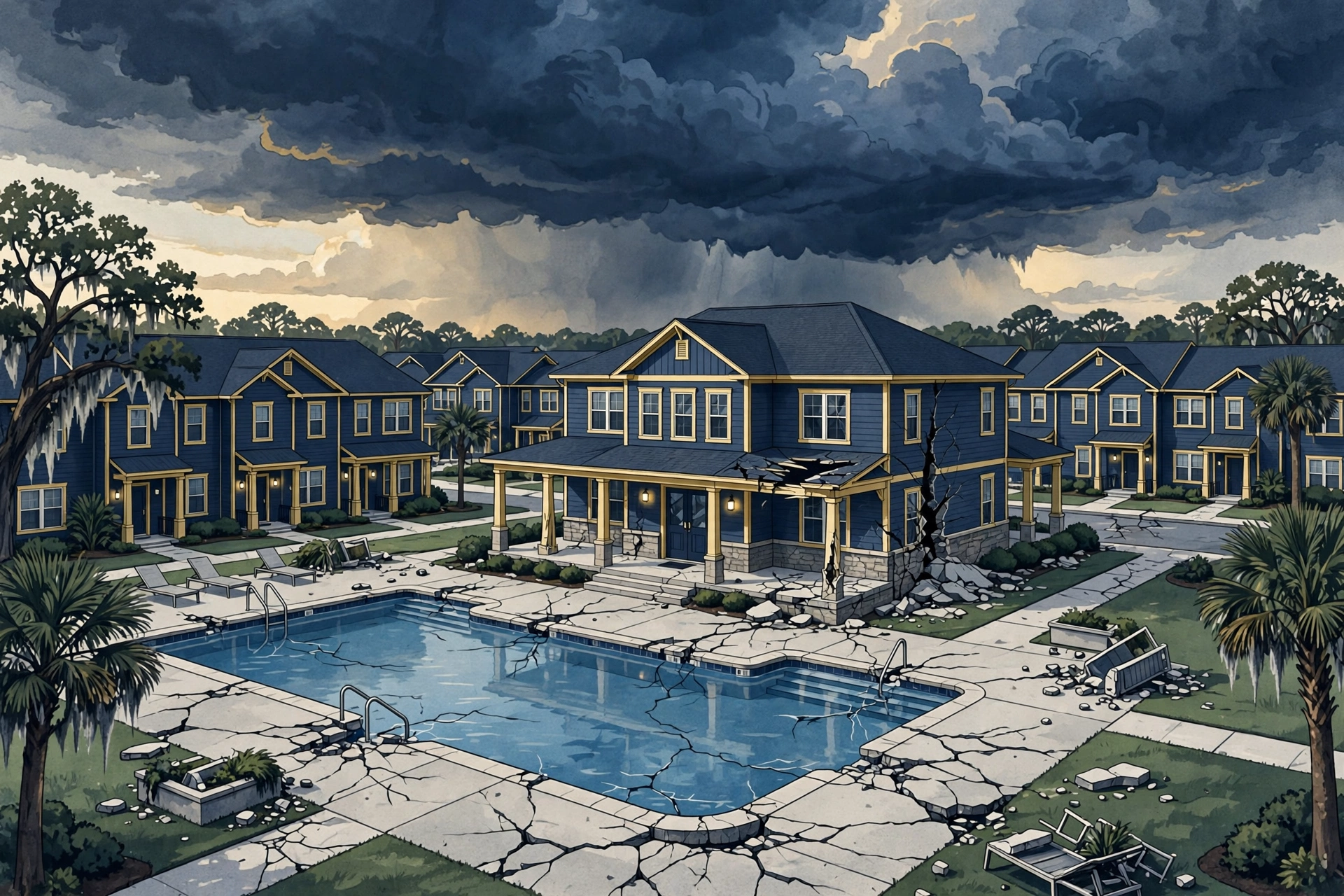
Your engineer just handed the board a report. The roofs on three buildings were installed wrong. The stormwater system cannot handle a normal Lowcountry rain. The private roads are failing two years after the developer turned them over. The repair estimate is $900,000, and the reserve account holds $60,000.
The homeowners did not cause this. The developer built it wrong. The question is whether the HOA can make the developer pay — and the answer, in South Carolina, is often yes, if the board acts before the legal deadlines run out.
Can an HOA Sue the Developer for Construction Defects?
Yes. A South Carolina homeowners association can sue the developer for construction defects in the common areas. The HOA is the party with standing to bring claims for damage to property it owns or is obligated to maintain — the roofs, roads, drainage systems, building exteriors, elevators, and amenities the whole community shares.
Individual homeowners generally cannot sue the developer for common-area defects on their own, because they do not own those areas individually. The association holds that claim. That is why developer-defect cases are association cases: one plaintiff, one expert study, one recovery that fixes the shared property for everyone.
The claims an HOA can bring include breach of contract (the declaration and purchase documents are contracts), breach of express and implied warranties, negligence in construction, and breach of fiduciary duty by the developer and its appointed board members. Which claims fit depends on the governing documents, the warranties in the purchase paperwork, and how the developer ran the community.
Developer-Controlled HOA vs. Homeowner-Controlled HOA: The Transition
Every South Carolina HOA starts under developer control. The developer creates the association, writes the declaration, and appoints the first board — usually its own employees or affiliates. This is the declarant-control period. The developer keeps control through weighted voting rights spelled out in the declaration until a turnover trigger in the declaration: a percentage of lots sold, a date, or the developer's voluntary surrender.
Transition is the handoff of board control from the developer's appointees to directors elected by the homeowners. It is the most important moment in a community's legal life, because it is the first time anyone with an interest in finding defects is in charge of looking for them.
Here is the conflict the law recognizes: while the developer controls the board, the board will not sue the developer. The developer's own appointees do not commission engineering studies of the developer's work, do not file warranty claims against the developer, and do not fund reserves at levels that reflect the true cost of fixing the developer's mistakes. Every year of developer control is a year the statute of limitations and the statute of repose keep running while nobody is watching the clock.
When homeowners elect a majority of the board, the developer must relinquish control and turn over the association's property at its own expense: the declaration, articles, bylaws, minutes, financial records, funds, insurance policies, warranties, and contracts. The Restatement (Third) of Property, cited in South Carolina legislative study materials on HOA governance, states this turnover duty expressly and requires the records to be audited by an independent certified public accountant. Your declaration will have its own version of this duty. Read it before transition, and demand every document it lists.
Common Area Defects: Who Is Responsible for Paying?
The short answer: the party that caused the defect pays — but only if the HOA pursues the claim in time. The long answer depends on what the defective item is and who owns or maintains it.
If the defect is in a common element — the roof, the foundation, the main walls, the roads, the drainage system, the elevators, the clubhouse — the developer and its contractors are the responsible parties, and the HOA is the party that sues them. If the defect is inside an individual unit and the declaration makes the unit owner responsible for the interior, that owner pursues their own claim under their purchase warranty.
The expensive fights are always about the gray areas: balconies, windows, siding, waterproofing membranes, and building envelopes where the declaration splits responsibility between the association and the owner. Before spending money on experts, the board needs a lawyer to map each defect to the declaration's maintenance matrix. Suing over an item the declaration assigns to unit owners wastes the association's money; missing an item the declaration assigns to the HOA waives the association's claim.
What Counts as a Common Element Under the SC Horizontal Property Act?
For condominiums, the South Carolina Horizontal Property Act (S.C. Code Title 27, Chapter 31) defines the playing field. Section 27-31-20(f) defines "general common elements" to include:
- The land the building stands on
- Foundations, main walls, roofs, halls, lobbies, stairways, and entrance and exit ways
- Basements, flat roofs, yards, and gardens
- Central service installations: power, light, gas, hot and cold water, refrigeration, water tanks and pumps
- Elevators, garbage incinerators, and all devices installed for common use
- All other elements of the property rationally of common use or necessary to its existence, upkeep, and safety
That last category is deliberately broad. It catches the building envelope, the waterproofing, the structural frame, and the site drainage — the exact systems where developer defects hide and where repair bills run into six and seven figures.
For non-condominium HOAs (single-family subdivisions, townhome communities), the declaration and plats — not the Horizontal Property Act — define the common areas. But the concept is identical: the shared infrastructure the developer built and the association now maintains.
Common Elements vs. Limited Common Elements: Why the Distinction Matters
Section 27-31-20(g) defines "limited common elements" as common elements reserved for the use of certain apartments to the exclusion of others — a private balcony, a designated parking space, a stairway serving one floor.
The distinction matters for two reasons. First, maintenance responsibility often splits: the association may maintain general common elements while the benefited owners maintain (and pay assessments for) limited common elements. Second, defect claims follow the money: a defect in a limited common element may be the association's claim, the benefited owners' claim, or both, depending on the declaration.
In litigation, developers exploit this ambiguity. They argue the leaking balcony is a limited common element the owners must fix themselves; the HOA argues it is part of the building envelope the developer warranted. The declaration's definitions section decides the argument. This is document work, and it has to happen before the expert starts drilling test holes.
Warranty Claims Against the Developer and Builder in South Carolina
Warranties are the HOA's most direct weapon, and they come in three forms.
Express warranties are written promises: the one-year builder warranty in the purchase contract, the roofing manufacturer's 20-year warranty, the developer's warranty booklet. Read every one. They have notice requirements and deadlines, and missing a written-notice deadline can void the warranty.
Implied warranties arise by law. South Carolina recognizes an implied warranty that residential construction will be performed in a workmanlike manner and that the dwelling will be fit for habitation. For common elements, the HOA steps into the shoes of the homeowners to enforce these warranties against the developer-vendor.
Statutory and declaration warranties appear in the governing documents themselves. Many declarations require the developer to warrant the common areas for a period after turnover. These provisions are negotiable only before you buy — which is why the developer wrote them — but they are enforceable after.
One warning: developers routinely require warranty claims to go through "informal" processes — call the warranty department, let our crew take a look, we will send someone out. Every month spent in the developer's warranty runaround is a month closer to the statute of repose. Put every warranty claim in writing, keep copies, and set a hard deadline after which the HOA hires its own experts.
South Carolina's 8-Year Statute of Repose: The Clock Is Running
S.C. Code § 15-3-640 bars any action to recover damages from a defective or unsafe improvement to real property more than eight years after substantial completion. Substantial completion is defined by when the owner could use the improvement for its intended purpose (S.C. Code § 15-3-630(b)) — practically, that is often the date the building was first occupied or put to use — and the parties can fix the date by written agreement.
Eight years sounds generous. It is not. In a phased community, each phase has its own completion date — the clubhouse finished in 2019 has a different deadline than the Phase 3 buildings finished in 2022. Latent defects (bad waterproofing, undersized drainage, structural shortcuts) often do not manifest until year five or six. By the time the stains appear on the ceilings, the HOA may have eighteen months left to investigate, hire experts, send a demand, and file suit.
The statute of repose is absolute. Unlike a statute of limitations, it does not wait for discovery — it runs from completion whether or not anyone knew about the defect. This is the deadline that kills HOA defect cases. If your community is more than five years past turnover and no engineer has inspected the common elements, the board is gambling with the association's largest asset.
Underfunded Reserves: When the Developer Leaves the HOA Broke
Reserves are the association's savings account for future major repairs: roofs, roads, elevators, drainage. A proper reserve study inventories every common-area component, estimates its remaining useful life, and calculates the annual funding needed to replace it.
Developers have a structural incentive to underfund reserves. Low assessments sell homes; realistic assessments do not. So the developer-controlled board sets dues artificially low, seeds the reserve account with a token contribution, and never commissions a real reserve study. The homeowners inherit a community with twenty-year roofs, a ten-year road surface, and a reserve account that covers neither.
At transition, the new board should commission an independent reserve study immediately — not the developer's projection, a real one. If the study shows the reserves are catastrophically short of what the developer should have funded, that shortfall is itself a claim against the developer: breach of fiduciary duty by the developer-appointed board that set the funding levels. Document the gap with the study, not with outrage.
Known Defects and Property Condition Disclosures: What Sellers Must Disclose in SC
South Carolina's Residential Property Condition Disclosure Act (S.C. Code Title 27, Chapter 50) requires sellers of residential property to give buyers a disclosure statement — delivered before the real estate contract is signed, or as otherwise agreed in the contract itself (§ 27-50-50(A)) — covering known material defects — structural problems, plumbing and electrical issues, environmental hazards, and other conditions affecting value. The standard is actual knowledge: the seller must report what they know, and § 27-50-60 imposes a continuing duty to deliver a corrected disclosure statement (or make reasonable repairs before closing) if the seller learns of a material inaccuracy after delivering it. Owners who knowingly misstate or conceal material defects face suit under § 27-50-65.
South Carolina is otherwise a caveat emptor state — buyer beware — which makes the disclosure form the buyer's main protection. For HOA communities, the Homeowners Association Act requires governing documents to be recorded in the county land records to be enforceable (§ 27-30-130), which gives buyers constructive notice of them; buyers typically also receive the documents through the real estate contract's HOA addendum during due diligence, though that is a contract matter, not a statutory duty under Chapter 30.
What does this mean for defect litigation? Two things. First, if the developer or a resale seller knew about common-area defects — the board minutes discussed the drainage failures, the developer's engineer flagged the roof installation — and did not disclose them, that knowledge supports fraud and unfair-trade-practice claims on top of the construction claims. Second, HOA boards should preserve every disclosure form, every set of board minutes, and every engineering report from the developer-control period. Those documents are often the evidence that turns a warranty dispute into a fraud case.
The Developer's Fiduciary Duty While It Controls the Board
While the developer appoints the HOA board, those directors owe fiduciary duties to the association — the duties of loyalty, care, and good faith that every corporate director owes. A developer-appointed director who approves shoddy common-area work, waives warranty claims against the developer, sets assessments below the level needed to fund reserves, or approves contracts that benefit the developer's affiliates at the association's expense is not serving the association. He is serving the developer.
Courts in other states have held developer-appointed directors individually liable for exactly this conduct: failing to investigate defects, failing to fund reserves, and failing to disclose material facts about the condition of the common property. South Carolina's Nonprofit Corporation Act (Title 33, Chapter 31) requires directors to act in good faith, with the care of an ordinarily prudent person, in the association's best interests. A developer employee wearing a board-member hat does not shed those duties.
This matters strategically. Fiduciary-duty claims reach conduct that warranty claims cannot: the decision not to inspect, the decision not to sue, the decision to keep assessments low while the buildings deteriorated. And they reach individuals, not just the developer entity — which changes settlement dynamics completely.
How an HOA Board Pursues the Developer: Demand, Expert Study, Litigation
A serious defect claim follows a sequence. Skip steps and you weaken the case; rush to the courthouse without them and you look unreasonable to a judge.
1. Preserve everything. Board minutes, emails with the developer, warranty correspondence, the declaration and all amendments, plats, construction drawings if you can get them, every disclosure form. Issue a litigation-hold letter to the developer and the management company.
2. Commission an independent engineering study. Not the developer's engineer — your engineer. A destructive-testing inspection of roofs, envelopes, drainage, and structural systems, with photographs, test results, and a repair-cost estimate. This report is the foundation of everything: the demand letter, the warranty claim, and the complaint.
3. Commission a reserve study. You need the funding gap documented by a professional, not estimated by a board member with a spreadsheet.
4. Send a written demand. Identify each defect, cite the warranty or declaration provision breached, attach the engineer's findings, and give a deadline to repair or pay. This letter starts the paper trail and, in many cases, starts serious settlement talks — developers know what an engineer's report does to their leverage.
5. File suit before the deadlines. Name the developer, the general contractor, and the design professionals where the evidence supports it. Plead warranty, negligence, and fiduciary-duty claims in the alternative. Move fast once the expert work is done — the eight-year repose clock does not pause for negotiations.
6. Do not let the developer's "warranty process" run out your clock. Every HOA defect lawyer has watched a developer stretch a warranty inspection across fourteen months. Cooperate reasonably, document everything, and file before the repose deadline regardless of where the "process" stands.
I Help HOAs Take On Developers for Common-Area Defects
I represent South Carolina homeowners associations pursuing developers for defective common areas — leaking roofs, failed drainage, crumbling roads, bad siding and envelopes, defective amenities.
That work starts at transition: reviewing the declaration's turnover provisions, demanding the full document turnover the law requires, and getting independent engineering and reserve studies commissioned before the developer's people are gone and the records go with them.
It continues through warranty enforcement: putting every claim in writing, tracking every deadline, and refusing to let the developer's warranty department run out the eight-year statute of repose. And when the developer will not repair or pay, it means litigation — breach of warranty and contract claims against the developer and builder, negligence claims against the contractors and design professionals, and breach-of-fiduciary-duty claims against the developer-appointed directors who looked the other way while the defects were built in and the reserves were left empty.
If your board is staring at an engineer's report with a six- or seven-figure repair number — or if transition is coming and no one has inspected the common areas yet — talk to a lawyer before the deadlines do your deciding for you. Contact my office for a free consultation, or request a legal opinion through the intake page and I will tell you plainly whether your association has a case worth pursuing.
This article is general information about South Carolina law, not legal advice for any specific community. Every development's declaration, warranties, and deadlines are different.