Condo Construction Defects in South Carolina? How HOAs and Homeowners Sue the Developer
When every building in your South Carolina condo development leaks, cracks, or rots the same way, that is not bad luck — it is a construction defect, and it usually traces back to the developer and the original builders. Here is how condo regimes and HOA communities sue developers in South Carolina, what the association can recover for common elements, what individual homeowners can recover for their units, the 8-year deadline that controls everything, and how groups of homeowners band together to fund and win these cases.
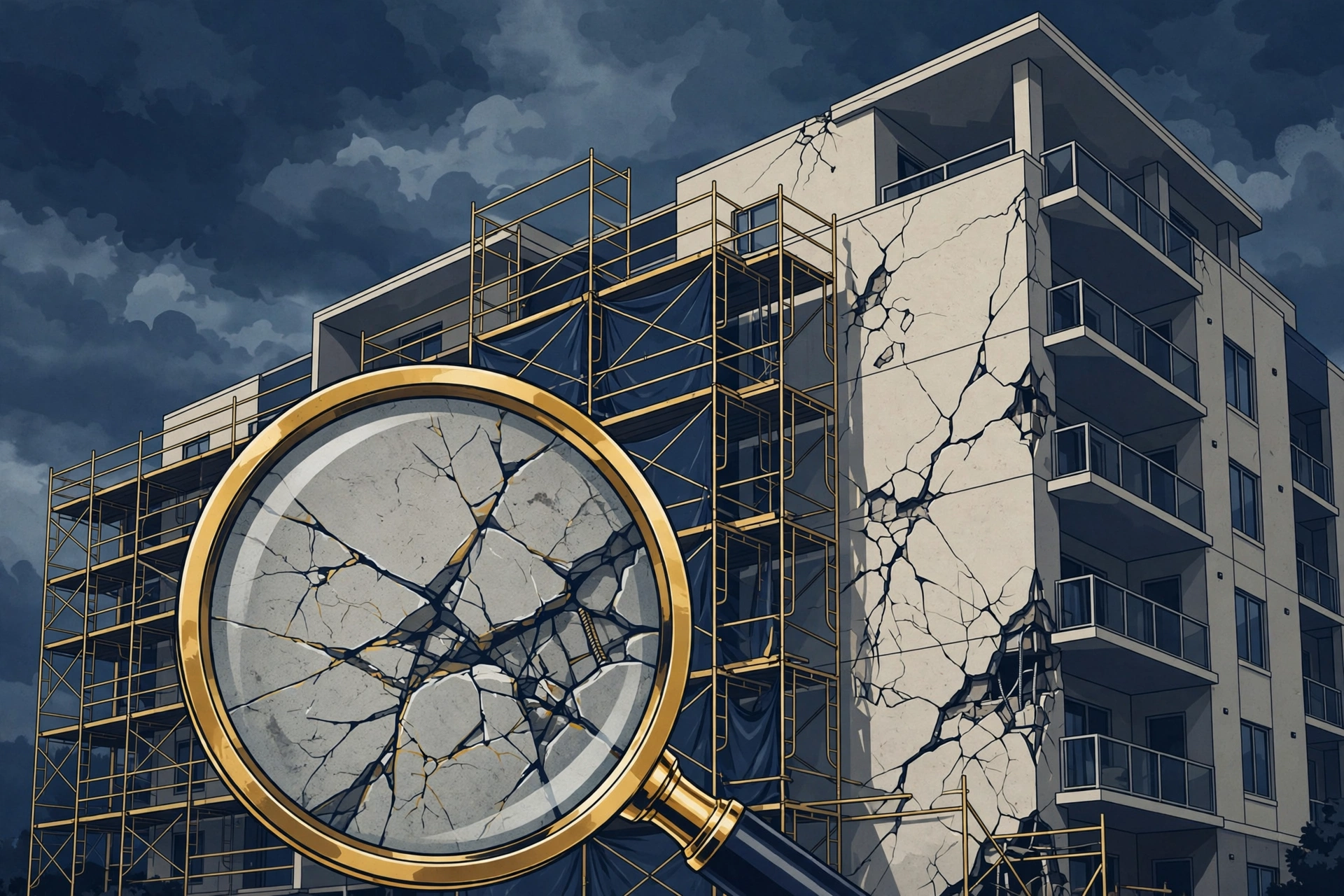
The stains appear along the windows first. Then the siding warps. Then an engineer opens up a wall and finds rotted framing behind stucco that looked perfect from the parking lot. And it is not just your building — it is every building in the development, built the same way, by the same developer, with the same defects.
This is the pattern in South Carolina condo and HOA construction-defect cases. One defective building is a homeowner's problem. Fifty defective buildings is a lawsuit against the developer — and these cases produce some of the largest residential recoveries in the state. A Charleston County jury awarded $7.72 million to 215 condo owners and their association over botched exterior construction at Twelve Oaks at Fenwick Plantation. In January 2026, a jury awarded the Greystone Homeowners Association $1,269,000 over defective exterior work on its 50-unit Mount Pleasant condominium development. In November 2025, a federal judge approved a $1.25 million settlement for owners at the Renaissance Tower condos in the Myrtle Beach area after structural deterioration forced an emergency shutdown (reported publicly in April 2026).
If your community is living this pattern, here is how South Carolina law treats it.
What Are Construction Defects in a Condo or HOA Community?
A construction defect is a failure in design, materials, or workmanship that causes a building or its systems to fall short of what the buyer paid for — and, critically, to fail prematurely. In single-family cases the defect affects one house. In condo regimes and HOA communities, the same developer typically built every unit from the same plans with the same crews and the same materials, so the same defect repeats across dozens or hundreds of homes.
South Carolina recognizes several legal theories for these claims. Negligence: the builder failed to exercise the care the work required. Breach of contract: the finished buildings did not match the plans, specifications, or promises. Breach of implied warranty: South Carolina courts recognize that builders carry an implied obligation to perform residential construction in a workmanlike manner. And where the developer's conduct involved deception — hiding known defects, misrepresenting the condition of the buildings — the South Carolina Unfair Trade Practices Act can add treble damages and attorney's fees.
The theory matters less than the proof. What wins these cases is an engineer's forensic investigation showing that the same failure exists across the development, tracing it to the original construction, and pricing the repair.
Common Elements vs. Your Unit: Who Owns the Problem?
This is the threshold question in every condo defect case, and South Carolina's Horizontal Property Act answers it. Under S.C. Code § 27-31-60, each unit owner has exclusive ownership of the individual apartment plus a shared interest in the common elements proportional to the unit's value. Section 27-31-70 provides that common elements — both general and limited — remain undivided and cannot be partitioned.
In practice, the dividing line runs like this. The association owns the claim for defects in common elements: roofs, exterior walls and siding, foundations, structural framing, common plumbing and electrical systems, drainage and grading, parking structures, and building envelopes. Individual owners own the claim for defects inside their units: interior finishes, appliances, and damage to personal property caused by the common-element failures.
The line blurs where defects migrate. Water entering through a defective common-element wall destroys drywall, flooring, and belongings inside the unit. Good cases plead both: the association pursues the building-envelope defects, and individual owners pursue the interior damage those defects caused. The governing documents — the master deed, declaration, and bylaws — refine these boundaries, so the first document any lawyer reads is the declaration.
Can an HOA Sue the Developer for Construction Defects in South Carolina?
Yes. South Carolina associations routinely bring construction-defect suits against developers, builders, and general contractors, and the case law is full of them. The Summerlake Townhomes Homeowners' Association sued developer True Homes over defects across its York County townhome community. The Stoneledge HOA pursued its developer and contractors through the South Carolina Court of Appeals over waterproofing, flashing, siding, and structural failures. The Persimmon Hill HOA litigated defects across 74 buildings and 388 units.
The association typically sues on two bases: its own claim for damage to the common elements it is charged with maintaining, and — depending on the governing documents — claims assigned to it by or brought on behalf of the individual owners for defects affecting their units. The Horizontal Property Act permits the council of co-owners to incorporate for administration of the regime (S.C. Code § 27-31-90), and the declaration and bylaws spell out the board's authority to litigate. Before filing, the board should confirm that authority in its own documents and, where the documents require it, obtain the owner vote the declaration demands for litigation.
One practical warning from the Greystone case: not every theory survives. The jury awarded Greystone $1,269,000 on breach of contract and warranty claims, but the court directed a verdict against the association on its SCUTPA claim, and the verdict is on appeal (App. Case No. 2026-000912; appeal filed April 2026). Plead every viable theory, but build the case on the contract and warranty claims that actually carry these verdicts.
Developer Control vs. Homeowner Control: Why Timing Matters
Most South Carolina developments begin with the developer controlling the HOA. The developer appoints the board, writes the budget, hires the management company, and — critically — decides whether the association investigates construction problems. While the developer controls the board, defect claims against the developer tend not to get filed. That is not a coincidence.
Transition to homeowner control changes everything. Once owners elect their own board, the new board typically commissions the first independent engineering inspection the community has ever had. That inspection is when the scope of the defects becomes visible — and when the clock starts running in earnest.
Two consequences follow. First, evidence from the developer-control period matters: board minutes, reserve studies, repair records, and communications showing what the developer knew and when it knew it. If the developer-controlled board received engineering reports flagging deterioration and did nothing — as reporting showed at Renaissance Tower, where deterioration was documented as early as 1998 — that evidence goes to the heart of the case. Second, the transition itself can create claims: inadequate reserves at turnover, undisclosed known defects, and misrepresentations in the developer's disclosures to buyers.
The Most Common Defect Clusters in SC Condo Developments
South Carolina's climate punishes bad building envelopes, and the defect patterns repeat across developments:
Water intrusion through the building envelope. Failed flashing around windows and doors, missing or defective weather barriers behind stucco and siding, and improper deck and porch waterproofing. Water gets in, wood rots, mold follows. In the Stoneledge case, the HOA's forensic engineer found water intrusion had damaged roofs, windows, balconies, and foundations, and that firewalls between units were improperly installed — the full cascade from one root cause.
Stucco and siding failures. Improperly installed stucco without adequate drainage planes traps moisture against sheathing. Warped, cracked, or detaching siding signals the same underlying envelope failure. The Twelve Oaks verdict centered on damage concealed behind stucco exteriors.
Roofing defects. Improper installation, inadequate underlayment, and defective materials produce leaks that compound over years. Because roofs are common elements, the association carries these claims.
Foundation and structural defects. Cracked slabs, differential settlement, and improperly constructed fire-rated walls between units. Structural issues are the most expensive to remediate and the most dangerous to ignore — the Renaissance Tower emergency shutdown shows where neglected structural deterioration ends.
Drainage and grading. Site work is a developer responsibility, and when grading and stormwater systems are done wrong, entire neighborhoods flood. Foundation drainage failures rot the lowest framing first.
Plumbing, electrical, and HVAC. Systemic installation defects — undersized HVAC, code-violating wiring, defective plumbing rough-ins — repeat unit to unit when the same subcontractors did every building.
If your community shows the same symptom in building after building, stop treating each unit as an isolated repair. That pattern is the case.
What Damages Can Homeowners and HOAs Recover?
Construction-defect damages in South Carolina fall into several buckets:
Cost of repair. The primary measure: what it costs to fix the defects properly, established through contractor estimates and engineering opinions. In Twelve Oaks, the plaintiffs told the jury it would cost $15.7 million to fix the buildings — and the jury awarded the $7.72 million balance after crediting $8 million already recovered in settlements.
Diminished value. Where defects cannot be fully remediated or stigma attaches to the development, the loss in market value beyond repair cost.
Relocation and loss of use. When buildings are unsafe or uninhabitable during repairs — as at Renaissance Tower, where owners were forced out for nearly five months — temporary housing costs and related losses are recoverable.
Interior and personal-property damage. Damage inside units caused by common-element failures: ruined drywall, flooring, furnishings, and mold remediation.
Consequential losses. Special assessments owners paid for stopgap repairs, increased insurance costs, and engineering and inspection fees incurred investigating the defects.
Punitive damages and SCUTPA treble damages. Available where the developer's conduct was willful or deceptive — knowingly concealing defects, misrepresenting building condition, or selling units while sitting on engineering reports showing systemic failure.
The association recovers for common elements; individual owners recover for their units and personal losses. Structured correctly, the two tracks run in one case.
South Carolina's 8-Year Deadline for Construction Defect Lawsuits
This is the deadline that kills more defect cases than any other. S.C. Code § 15-3-640 provides that no action to recover damages arising from the defective or unsafe condition of an improvement to real property may be brought more than eight years after substantial completion of the improvement. The statute expressly covers contract claims, negligence claims, economic-loss claims, and actions against owners and other interest holders.
Read that carefully: eight years from substantial completion, not from discovery. South Carolina does not toll this deadline because the homeowners had not found the defect yet. A community that discovers systemic water intrusion in year nine is in serious trouble regardless of when the rot started.
Practical consequences for boards and homeowners:
- Determine substantial completion dates now. For phased developments, each phase may have its own date — and its own deadline.
- Do not let the developer run out the clock. Developer-controlled boards have every incentive to delay investigation. Homeowner boards should commission independent engineering inspections promptly after transition.
- The deadline can expire while you negotiate. Talking to the developer about repairs does not stop the clock. If the deadline is approaching, file to preserve the claim; you can always settle later.
- Successor purchasers inherit the problem and the deadline. Buying a resale unit in a defective development does not restart anything.
If your development is anywhere near the eight-year mark, treat the deadline as an emergency.
Do Sellers Have to Disclose Known Construction Defects in South Carolina?
South Carolina follows caveat emptor — buyer beware — but the Residential Property Condition Disclosure Act (S.C. Code Title 27, Chapter 50) carves out a major exception. Sellers of residential property must complete the state's disclosure statement based on their actual knowledge (§ 27-50-40(A)): what the seller genuinely knows about the property's condition, including structural defects, water intrusion, and environmental hazards. And § 27-50-65 authorizes suits against owners who knowingly misstate or conceal material defects.
For condo and HOA resales, this cuts two ways. A seller who knows the buildings have systemic water intrusion — because the board discussed it, because special assessments were levied for repairs, because an engineer's report circulated — and checks "no" on the disclosure form faces personal liability to the buyer. Conversely, a buyer who discovers post-closing that the seller knew about building-wide defects has a direct claim against that seller, separate from any claim against the developer.
Developers selling new units face the same exposure magnified: a developer that sells units while holding engineering reports documenting systemic defects is the textbook case for fraudulent concealment and SCUTPA liability. Preserve every disclosure statement, every board communication, and every engineering report. In defect litigation, the paper trail showing who knew what and when is often more valuable than the engineering itself.
How Groups of Homeowners Band Together Against a Developer
Big defect cases work because the economics work. One homeowner cannot fund a forensic engineering investigation and a lawsuit against a developer. Fifty homeowners, through their association, can. Here is how these cases are typically structured:
The association leads. The HOA or condo association, acting through its board, retains the engineer and the lawyer. The association's claim for common-element defects is usually the largest single claim in the case, and the association has the standing, the documents, and the assessment authority to fund the fight.
Individual owners join. Owners with unit-level damage — interior water damage, mold, ruined finishes — bring individual claims alongside the association's claims, often in the same action. The Summerlake litigation followed this structure: the association plus individual owners suing together.
Costs are shared. Engineering investigations, destructive testing, and expert testimony are expensive. Spread across dozens of units through the association, the per-owner cost is manageable. Many construction-defect firms also work on contingency or hybrid fee arrangements, so the community is not writing blank checks.
Watch for arbitration clauses. Developers increasingly bury arbitration provisions in purchase agreements and declarations. In Summerlake, the developer moved to compel arbitration of individual owners' claims based on purchase-agreement clauses. Arbitration is not fatal — defect claims can be won there — but it changes the forum, the procedure, and sometimes the available remedies. Have a lawyer review the declaration and purchase agreements before assuming the case belongs in court.
The developer will point at the subcontractors. Expect it. Developers routinely blame the framing crew, the stucco contractor, the roofer. Good complaints name the potentially responsible subcontractors from the start or use the developer's own finger-pointing to expand the case. The Persimmon Hill litigation shows how this plays out: the HOA settled with the developer and pursued the framing subcontractor to a default judgment exceeding $4 million.
Settlement often comes in waves. Twelve Oaks settled with some defendants for $8 million before taking the rest to trial for the remaining $7.72 million. Structure the case so early settlements fund the fight against the remaining defendants, not so they end it prematurely.
What to Do the Moment You Suspect Building-Wide Defects
If the same symptom is appearing in multiple buildings, move quickly and in this order:
- Document everything. Photograph every stain, crack, warp, and leak, in every building, with dates. Collect owner complaints in writing.
- Preserve the paper trail. Board minutes, reserve studies, management company communications, developer disclosures, prior engineering reports, repair invoices. Issue a written litigation-hold notice to the board and management company.
- Commission an independent forensic engineering inspection. Not the developer's engineer. Not a contractor's free estimate. A licensed forensic engineer who does destructive testing — opening walls — and writes a report tracing defects to original construction.
- Check the calendar. Determine substantial completion dates for each phase and measure them against the 8-year deadline in § 15-3-640. If the deadline is close, act as though it is an emergency, because it is.
- Review the governing documents. Confirm the board's authority to investigate and litigate, and check for arbitration clauses and litigation-approval requirements.
- Do not sign releases. Developers facing defect claims sometimes offer individual owners small settlements with broad releases. Do not sign anything until a lawyer reviews it — a release signed by one owner can complicate the community's case.
- Get counsel before confronting the developer. How the claim is first presented — the engineering report, the demand, the preservation of evidence — shapes everything that follows.
Before you file: the 90-day right-to-cure notice. South Carolina’s Notice and Opportunity to Cure Construction Dwelling Defects Act (S.C. Code Ann. §§ 40-59-810 to -860) requires the claimant to serve the contractor with a written notice of the defect at least 90 days before filing a construction-defect suit. The contractor then gets 30 days to inspect, offer to repair, offer a settlement, or deny the claim. Skip the notice and the court stays the case until you comply — and the notice process does not extend the 8-year deadline, so start it with time to spare.
I Represent Groups of Homeowners and HOAs in Construction-Defect Cases
I represent homeowner groups and community associations pursuing construction-defect claims against developers, builders, and general contractors for building-wide defects. That work includes:
- Forensic investigation strategy — retaining the right engineers, scoping destructive testing across the development, and building the building-by-building defect record these cases require.
- Association claims for common elements — roofs, siding and building envelopes, foundations, drainage, and structural systems — plus coordination of individual owners' unit-damage claims in the same action.
- Developer-transition claims — inadequate reserves at turnover, undisclosed known defects, and misrepresentations during the developer-control period.
- Disclosure and fraud claims — sellers and developers who concealed known defects from buyers, including claims under the Residential Property Condition Disclosure Act and the South Carolina Unfair Trade Practices Act.
- Defeating delay tactics — arbitration fights, finger-pointing at subcontractors, and statutes-of-repose defenses, addressed before they derail the case.
These cases are won by communities that organize early, investigate independently, and file before the deadline expires. If your development shows the same defects building after building, the pattern is the evidence — and the clock is already running.
Contact Traywick Law Offices for a free consultation about your community's construction defects. The initial review covers your governing documents, your timeline against the 8-year deadline, and whether your community's defect pattern supports a case.