Condo Association Won't Fix the Roof, Elevators, or Common Areas? A Myrtle Beach Owner's Playbook
When a Myrtle Beach condo association won't fix the roof, elevators, or other common elements, the duty lives in your recorded bylaws, the money duty is in state law, and an aggrieved owner has a right of action. This playbook shows the escalation ladder.
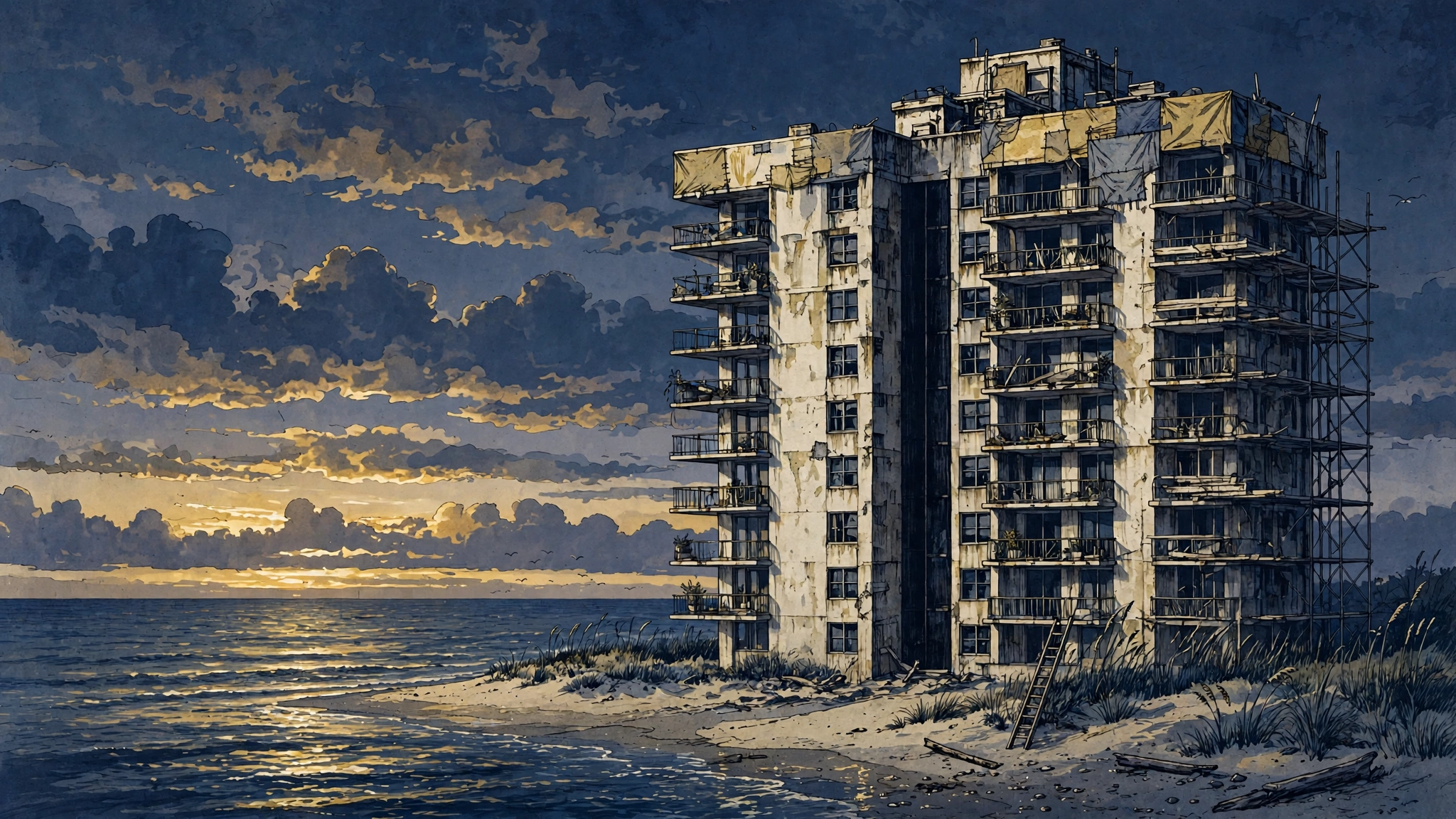
The stain on the ceiling grows after each rain. The elevator is out again, with a note taped to the door for weeks. Concrete spalls off the balcony edge. You report it, and report it again. The manager says the board is aware. Nothing is scheduled, and your regime fee is due on the.
You are not alone in Horry County. The South Carolina Department of Consumer Affairs reported that Horry County produced 31 percent of all homeowners association complaints in the state in 2025. Maintenance and repair concerns made up 11.7 percent of complaints statewide, the second largest category. And 98 percent of complainants said they had already raised the concern with the association first. Owners report first. Boards stall anyway.
This post is the lever,. It maps which parts of a tower are common elements, states precisely where the maintenance duty lives in South Carolina law, separates a building built wrong from one maintained never, and works an escalation ladder from written notice to suit. For the broader picture, see our South Carolina HOA and POA homeowner rights guide.
Which parts of a Myrtle Beach condo tower are common elements the association must fix?
Section 27-31-20 divides a condo property into units, which the Act calls apartments, and common elements. General common elements include the land, foundations, main walls, roofs, halls, lobbies, and stairways, and central service installations such as power, light, gas, and water, plus all other elements rationally of common use or necessary to the property's existence, upkeep, and safety. Limited common elements are reserved for a certain number of units, such as special corridors, stairways, elevators, and sanitary services common to a particular floor.
Translate that into a Grand Strand tower. The roof, exterior walls, structure, and foundation are general common elements, as are hallways, lobbies, and stairways. Central plumbing stacks and shared systems fall within the central services language. Elevators appear as limited common elements in the statute's examples, and most deeds treat them as common systems. Balcony structure — concrete, supports, and waterproofing — is common in most Grand Strand master deeds, even when a deed assigns the surface differently.
Unit-owner items sit on the other side: inside finishes, appliances, fixtures, and pipes and wiring serving only your unit, plus damage the documents assign to you. The hard fights live at the boundary. A balcony slab and waterproofing may be common while tile an owner installed is not. A failed stack is a common system; a failed supply line inside one unit is not; the drywall torn out to reach the stack is assigned by the documents.
So the first task is to read the master deed's common element description and unit boundary definition, alongside the bylaws' maintenance section. State law supplies the vocabulary. Your documents draw the lines. Never accept a manager's oral summary. Ask for the page and quote it in your notice.
Where does a South Carolina condo regime's duty to maintain the common elements actually come from?
The Horizontal Property Act does not contain a freestanding section that says, in one sentence, the council or the board shall maintain and repair the common elements. No such operative sentence exists in the Act outside the insurance repair provisions. Do not quote one. It is not there.
What the Act does is require the duty to exist in your documents, and then fund it. Section 27-31-150 says administration is governed by bylaws recorded with the master deed. Section 27-31-160(c) requires those bylaws, as one of five mandatory subjects, to provide for care, upkeep and surveillance of the property and its general or limited common elements and services. Bylaws silent on care and upkeep would violate the Act's own requirements.
The money side is statutory and direct. Section 27-31-190 binds every co-owner to contribute, in the percentages computed under § 27-31-60, toward administration and maintenance and repair of the general common elements and, in the proper case, of the limited common elements, and toward any other expense lawfully agreed upon. No owner may escape by waiving use of the common elements or abandoning the unit. Owners fund upkeep whether they use the amenities or not.
Put the layers together. The statute requires your bylaws to provide for care and upkeep of the common elements, and requires every owner to fund their maintenance and repair. Your documents then state the regime's specific duties. A board that refuses to fix a roof its bylaws charge it with caring for commits a document breach inside a statutory frame, and the remedy runs through compliance with those documents.
Built wrong vs. maintained never: two different cases
Some towers fail because they were built wrong: defective stucco or flashing, bad window installation, missing waterproofing, work that never met the plans. Those are construction defect claims, with their own defendants, proof, and deadlines. If your problem traces to original construction, read our guide to a South Carolina condo and HOA construction defect lawsuit and have the deadlines checked at once.
Other towers were built soundly and then maintained never. Roofs past service life. Sealant joints never renewed. Steel left uncoated in salt air. Elevators run past modernization age on patch repairs.
What Renaissance Tower teaches about waiting too long to fix common elements
WMBF News, in a December 2024 investigation drawn from documents obtained in the federal lawsuit, reported this timeline. A consulting engineering firm, SKA, identified deterioration of the crawl-space structural steel and the need for repairs in 1998. In 1999 and 2000 the firm prepared construction documents with remedial measures and told the board. The board disregarded that advice, and no documentation was filed after that until the 2022 emergency.
The federal class action complaint, as reported by ClassAction.org and by the firm that filed it, alleged more: a former manager told a resident around 2016 that the steel was in bad shape; an engineer told the board at least as early as 2018 that the steel was damaged and would keep degrading; a 2021 re-evaluation found it substantially more corroded and advised the board it could not delay; and the defendants spent on expensive non-structural projects instead. Those are allegations in a filed complaint, not court findings, and the case settled without a reported adjudication of them.
What is not merely alleged is the end. When work began in October 2022, contractors found steel so corroded that some column flanges had completely disintegrated, and the engineer found the building not structurally sound. On October 7, 2022, Horry County code enforcement and the board's engineer deemed the building unsafe and it was evacuated. More than 300 of its 322 units were emptied. Owners returned in February 2023, nearly five months later. A federal judge in November 2025 approved a $1.25 million settlement for people who owned on the evacuation date, with payouts after fees from $1,378 to $3,446, as WMBF reported in April 2026.
The lesson is not that every leaking roof ends in evacuation. It is that deferral compounds. Early, the fix is planned and done with owners in place. Late, the same fix is an emergency, priced under duress, with the building closed and owners paying twice.
The opposite fight at Kingfisher Inn: when owners say the building was closed without cause
A complaint filed on May 30, 2025 in Horry County Court of Common Pleas, by the Kingfisher Homeowners Association, its management company, and interval owners for 2,193 interval interests, alleges this. The association hired engineer Saul Martinez in 2021 for structural remediation and again in 2024 to inspect cracks in the concrete. Martinez opined the building was at risk of collapse and told Horry County officials, who on March 28, 2024 issued an unsafe order and closed the building. Martinez proposed a multimillion-dollar foundation project. In mid to late 2024, two other engineers concluded the building was not at risk of collapse. The complaint also alleges the 2021 work was defective, and it seeks lost rental income.
Do not state as fact that the building was safe, or that it was in danger of collapse. Both positions are in the record: one engineer's opinion closed it; the owners' lawsuit alleges two later engineers disagreed. A closure or seven-figure scope resting on one opinion should be read in full — report, photos, measurements, credentials. A second, independent engineer is how owners test whether the first opinion is a diagnosis or a sales document.
Beach Club II, in the Windy Hill section of North Myrtle Beach, shows the ordinary version of major work. A rental listing there discloses an exterior breezeway and balcony concrete repair and waterproofing project scheduled from October 2026 through March 2027, with walkways and balconies blocked at times. Ask your regime for the same three things. If it cannot produce them, the project is a statement, not a plan.
The escalation ladder when a condo association won't fix common elements
Step 1: Written notice with photos, dates, and the document page
Send the board and the manager a written notice, by a method that proves delivery, that does four things. Name the common element, using the master deed's own term. Describe the condition with dated photos and, for a leak, a log of each event: date, source, where water entered, what it damaged. Cite the bylaw section that provides for care and upkeep of that element and the master deed section that classifies it as common.
Keep the tone flat and factual. A notice is evidence. Owners who write “the stain doubled after the storm on March 4, photos attached” build a case. Owners who write only anger build a file the board can dismiss as a feud.
Repeat the notice after each new event. A roof that leaks fourteen times, in the pattern owners report in forum accounts nationally, is one documented failure with fourteen dated proofs. That count separates a maintenance dispute from a habitability emergency for a judge or a county official.
Step 2: Attend meetings, speak on the record, and build owner support
Go to board and owner meetings. Ask when the repair will be scoped, bid, and scheduled, and ask that your question and the answer be reflected in the minutes. A board that must say “no date” out loud, before other owners who pay the same fees for the same roof, behaves differently from a board answering one email in private.
Step 3: Demand the records that prove — or disprove — a repair plan
The core right is § 27-31-180. The board must keep a detailed, chronological book of receipts and expenditures, specifying maintenance and repair expenses of the common elements, and that book and its vouchers must be available for examination by all co-owners at convenient hours on working days set and announced for general knowledge. Use it to test what has actually been spent on this roof, elevator, or deck, and whether prior collections for this project were spent on it. Note the limit: § 27-31-180 grants examination of that book and its vouchers, not copies, and does not list contracts or minutes. Broader rights may exist for an incorporated regime under the Nonprofit Corporation Act.
Step 4: A formal demand letter citing the documents and § 27-31-170
Section 27-31-170 requires each co-owner to comply strictly with the bylaws, with rules lawfully adopted under them, and with the covenants in the master deed. Failure to comply is grounds for a civil action for damages or injunctive relief, or both, maintainable by the board on behalf of the council of co-owners or, in a proper case, by an aggrieved co-owner. That last clause is the owner's offensive tool: the section boards use against owners also gives an aggrieved owner an action when the regime breaks the documents.
A good demand letter does not plead “the law requires you to maintain the building” in the abstract. It quotes the master deed classification of the element, quotes the bylaw care and upkeep provision § 27-31-160(c) required, attaches the notice log and photos, states the damage the delay is still causing, and demands a defined cure — a signed contract and a start date — within a stated window. It closes by naming the relief § 27-31-170 allows: damages and an injunction.
Directors do not act in a vacuum. If the regime is incorporated, § 33-31-830 requires directors to act in good faith, with the care an ordinarily prudent person would exercise, and in a manner the director reasonably believes to be in the corporation's best interests. Under Fisher v. Shipyard Village Council of Co-Owners, Inc., 415 S.C. 256, 781 S.E.2d 903 (2016), the business judgment rule protects only acts within the board's authority, and failure to comply with affirmative duties in the documents falls outside its shelter. Our post on the South Carolina HOA board fiduciary duty and business judgment rule works through that standard.
Step 5: File the state complaint — with honest expectations
File a complaint with the South Carolina Department of Consumer Affairs if you want the record made. The department will record it, forward it to the regime, and count it in its public annual report. That report is leverage in a meeting. It is not an order.
Section 27-30-340(E) prohibits the department from serving as an arbiter between a homeowner and an association. It cannot order a repair or enforce your bylaws. Owners who wait for the state to compel a repair lose the season in which the case should have been filed. File the complaint and keep climbing the ladder.
Step 6: Sue for damages or an injunction — or both
If the regime will not cure, § 27-31-170 authorizes a civil action by an aggrieved co-owner, in a proper case, for damages or injunctive relief, or both. Damages reach what the failure cost you: interior damage tied to the failure, lost rent or use proved with records, and out-of-pocket costs. An injunction is an order that the regime scope the work, contract it, and complete it. Many owners value the order more than the money, because money alone leaves the roof leaking. Expect mediation in a Horry County circuit court case under the court-annexed ADR rules.
Should you hire your own engineer when the condo association won't fix a roof leak or structural damage?
In a structural, roof, or water intrusion fight, usually yes, and earlier than owners expect. An engineer's report identifies the element and the failure in terms that map onto the master deed, separates original defect from later deterioration, states urgency honestly, and defines the scope from which a price can be bid. That turns an argument about whether work is needed into an argument about which bid to accept.
Choose an engineer with no stake in performing the repair. A report written by the company that hopes to win the contract will be discounted by the board, a mediator, and a court, and Kingfisher shows the mirror risk: one interested opinion can close a building or launch a project other engineers later dispute. Get the report in writing, with photos and measurements, and send it to the board with your demand. A board that ignores a professional warning, without obtaining any report of its own, creates a damaging record.
What if the condition is an emergency?
When a condition threatens safety — spalling concrete above a walkway, a failing structural member, raw sewage from a broken stack — do not rely on the board's meeting calendar. Contact Horry County code enforcement for unincorporated areas, or the city building department inside a Strand municipality. Renaissance and Kingfisher both show county officials acting on engineering information to close property they deemed unsafe. Bring the photos, the dated log, and any engineer's letter you have.
An unsafe order is a blunt tool. It can force action owners have begged for across years. It can also empty a building and trigger costs no owner controls, as both anchor stories show in opposite directions. Use officials when safety is genuinely at stake, and state only what you can document. For non-emergency failures, the ladder above, ending in a § 27-31-170 action, is the controlled path.
Do not attempt self-help repairs to common elements. Cutting into a roof, a slab, or a central system without authorization can void warranties and breach the master deed. Document, demand, and, if needed, sue.
Why selling your Myrtle Beach condo does not escape a regime that won't make repairs
Industry and market reporting put September 2026 Grand Strand condo sales at a median of $219,500, down 8.2 percent, with 131 days on market and 8.2 months of supply, in Coastal Carolinas Association of Realtors figures reported by Grand Strand real estate sources. Treat those as market reporting, not a valuation of your unit. The mechanism is not in dispute: buyers ask for budgets and known repair needs, and lender guidance treats projects in need of critical repairs, including significant deferred maintenance affecting safety or structural integrity, as ineligible for agency financing. An unfixed building with no funded plan can lose financed buyers, leaving cash buyers who discount hardest.
Frequently asked questions when a condo association won't fix common elements
Is a condo association legally responsible for a roof leak into my unit?
The roof is listed in § 27-31-20 as a general common element, and your bylaws were required by § 27-31-160(c) to provide for care, upkeep, and surveillance of the common elements. If the water source is the roof or another common element, repair of that source is the regime's job under its documents, funded by the § 27-31-190 contributions every owner must make. Who pays for interior damage turns on your master deed's allocation and on proof of source, so a written source finding by a roofer or engineer matters more than a manager's guess.
My condo association won't fix the elevator. Is an elevator a common element?
It can be. Section 27-31-20 lists elevators among the examples of limited common elements, and most Grand Strand master deeds treat tower elevators as common systems the regime maintains. Read your master deed's schedule and your bylaws' maintenance section for the controlling term. Modernization of a common elevator system is a common expense shared by percentage interest, unless your documents state a lawful limited common element allocation that says otherwise.
Can I withhold my regime fee until the association makes the repair?
That is the riskiest response available. Section 27-31-190 states the contribution duty without a repair-based exception, and it bars an owner from exempting himself by waiving use of the common elements or abandoning the unit. Unpaid sums become a lien under § 27-31-210, which the regime may foreclose in like manner as a mortgage or pursue as a money judgment. Owners with a strong repair claim sometimes pay under written protest while pursuing the § 27-31-170 action, to keep the lien remedy out of the board's hands. Get advice on your documents before withholding.
The association fixed the leak source but won't pay for my drywall, ceiling, or mold work. Who pays?
This is the boundary fight owners report most often in forum accounts nationally: the regime repairs its pipe or roof, then denies the interior restoration the failure caused. South Carolina law does not answer it with one sentence. The master deed's unit boundary and maintenance sections allocate interior components, and § 27-31-170 damages can reach loss caused by failure to comply with the documents. Proof decides: a documented common-element source, a dated notice record, and invoices separating source repair from interior restoration.
Will filing a complaint with the state force my regime to fix the common areas?
No. The department will record your complaint, forward it to the regime for a response, and count it in the public annual report. Section 27-30-340(E) prohibits the department from serving as an arbiter. It cannot order a repair, award money, or enforce your bylaws. Horry County owners file in the highest numbers in the state, yet consumers were satisfied in fewer than one percent of complaints counted in the 2025 report. File for the record. Sue, if needed, for the repair.
Your first two weeks: a Myrtle Beach repair checklist
Read the master deed and bylaws and mark three pages: the common element description, the unit boundary, and the care and upkeep provision. Photograph the condition with dates and start the event log. Send the Step 1 notice with photos, document pages cited, and a stated cure date,. Calendar the board's next meeting and appear with one question about scope, bid, and schedule. If the answer is still no plan, send the § 27-31-180 examination demand.
If the condition involves structure, active water intrusion, an elevator or deck safety question, or a board that will not produce any repair record, have a South Carolina condo lawyer review the file before the next fee cycle passes. You can start with a free consultation request and bring the master deed, bylaws, photo log, and every written answer the regime has given you.
This post gives general legal information about South Carolina law. It is not legal advice about your facts, and reading it does not create an attorney-client relationship. Maintenance duties in a South Carolina condo turn on the master deed and bylaws of the particular regime. Talk with a South Carolina lawyer about your situation before you act.