Developer Dumping: When Builders Stick SC Homeowners With Worthless Common Areas
Developers sometimes convey roads, ponds, and drainage to the HOA by $5 quitclaim deeds — while reserving the valuable easements for themselves. South Carolina courts call this "unloading." Under Goddard, Dunes West, and Walbeck, developers owe a fiduciary duty to turn over common areas in good repair or fund the repairs — and liability survives turnover.
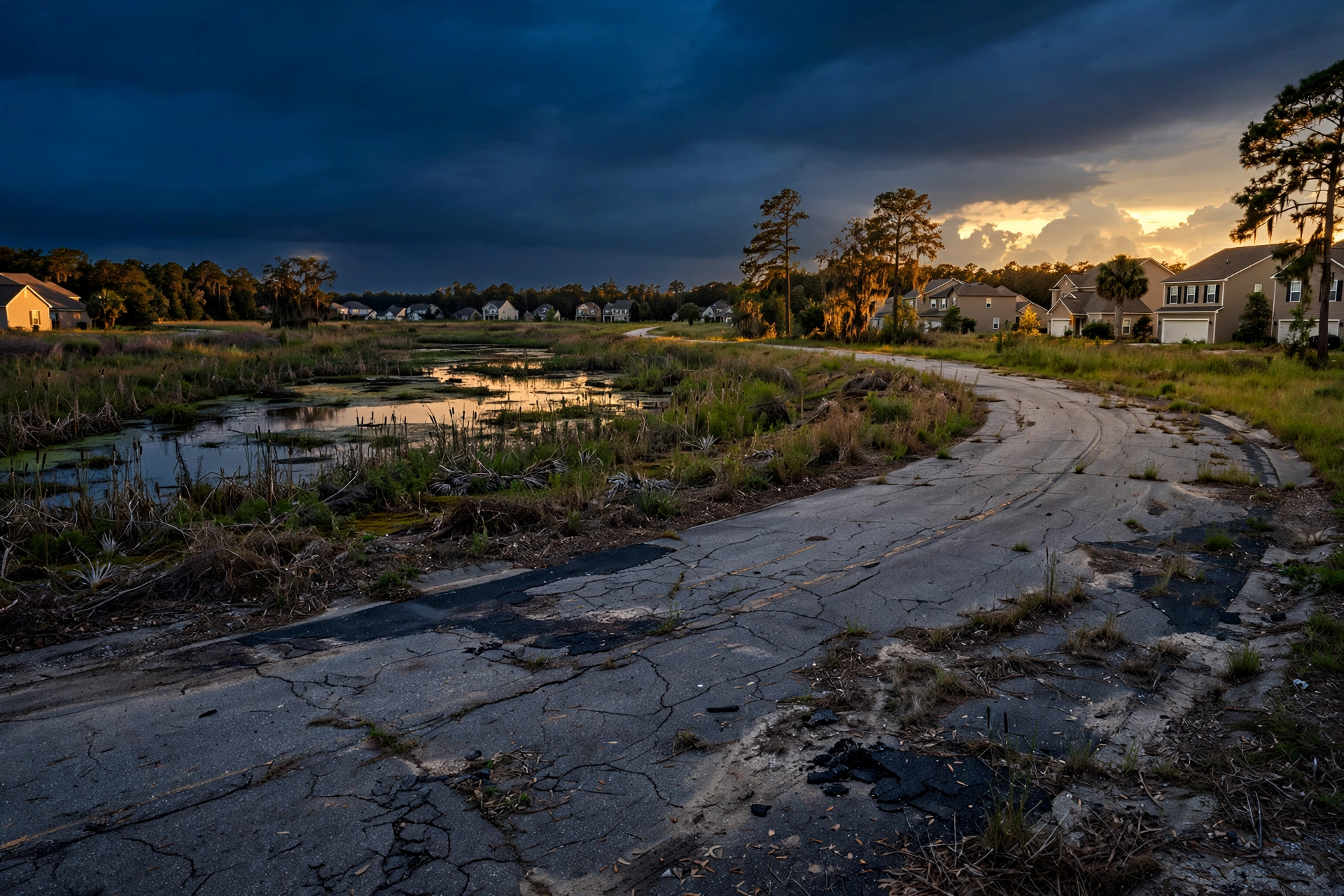
The new homeowner board takes control of the association, opens the files, and finds the surprise the developer left behind: miles of private roads the county won't maintain, stormwater ponds that are silted in, drainage that floods every hard rain, entrance monuments crumbling — all of it deeded to the HOA, none of it funded, and the repair bill landing on homeowners who never voted for any of it.
Consumers call it developer dumping. South Carolina courts have a word for it too — "unloading" — and a line of cases that makes it one of the strongest homeowner claims in this state's HOA law. This post is part of Traywick Law's series on HOA problems in South Carolina. It explains the playbook developers use, what South Carolina courts actually say about it, and — just as important — the honest limits of the doctrine.
What Is Developer Dumping? How Builders Stick Homeowners With Worthless Common Areas
Developer dumping is the endgame economics of a residential development: extract the value, socialize the costs. In the developer's ideal version, every liability in the community — roads, ponds, buffers, wetlands, drainage infrastructure — ends up titled in the HOA's name, while every valuable right stays with the developer.
It shows up in the questions homeowners actually ask: "Can my HOA be forced to accept common areas from the developer?" "The developer gave us the roads but kept an easement — is that legal?" "Our developer conveyed the ponds by quitclaim deed and now the county says they're ours to fix." The answers run through a fiduciary-duty doctrine South Carolina courts have built across three decades: a developer that controls an association owes the association a duty analogous to a corporate promoter's duty to investors, and common areas must change hands in good repair — or with the money to fix them.
No South Carolina opinion uses the word "dumping." The term of art is "unload," from Goddard v. Fairways Development General Partnership, 310 S.C. 408, 426 S.E.2d 828 (Ct. App. 1993) — the foundational case, and still the rhetorical heart of every dumping claim in this state.
The 6-Step Dumping Playbook: How Developers Hand Homeowners the Bill
Dumping isn't an accident. It's a sequence, and recognizing the steps is how a homeowner board knows what happened to it:
Step 1 — Plat the liabilities as "common areas." In the declaration, the developer designates everything it doesn't want to maintain or pay taxes on as association property: roads, stormwater ponds, drainage easements, landscape buffers, wetlands, entrance features.
Step 2 — Strip the value first. Before conveying anything, the developer reserves what matters: private ingress/egress easements over the roads, utility easements, development rights on adjacent phases, signage rights, sometimes mineral or timber interests. The HOA gets the fee title; the developer keeps the useful sticks in the bundle. A pattern we see repeatedly: developers conveying roads to the association by $5 quitclaim deeds while reserving easements that let them keep using — and controlling — those same roads.
Step 3 — Convey by quitclaim, for nominal consideration. The standard instrument is a quitclaim deed for $5 or $10. A quitclaim conveys whatever interest the grantor happens to have — with no warranties of title, condition, or fitness. No representation the roads were built to county standards. No promise the pond isn't silted in. No reserves.
Step 4 — Alternatively, "dedicate" to the public. Sometimes the developer (or the captive developer-controlled board) records a dedication of the streets "to the use of the public forever." That sounds generous. But a dedication does not obligate the county to maintain the roads unless the county formally accepts both the dedication and the maintenance obligation. An unaccepted dedication leaves the HOA holding private roads it thought it gave away — the worst of both worlds.
Step 5 — Defer the maintenance. During declarant control, the developer keeps assessments low — "low HOA dues!" is a sales tool — and defers capital work. Reserves stay near zero. The wear accumulates on the developer's watch.
Step 6 — Hand over the bill at turnover. The homeowner board inherits road repaving, pond dredging, drainage repair, and entrance rebuilds — funded by special assessments levied on people who never voted for any of it.
Can My HOA Be Forced to Accept Bad Common Areas?
This is the question that brings homeowners to a lawyer's door: the developer just deeded us a road system (or ponds, or drainage) in terrible condition, with no money attached. Do we have to accept it?
The deed is usually already recorded, so "refusing" it isn't really the move. The move is making the developer pay for what it handed over. That's where the case law comes in — and South Carolina's is unusually homeowner-friendly.
South Carolina Courts Call It "Unloading": Goddard v. Fairways Development
In Goddard, a developer retained superior voting rights over a planned community until near-complete buildout, transferred the common areas to an HOA of only five owners stuck maintaining everything, and kept assessments artificially low. The Court of Appeals held that a developer controlling a POA owes fiduciary duties to the owners association "much like that owed by promoters of a corporation to investors" — citing Duncan v. Brookview House, Inc., 262 S.C. 449, 205 S.E.2d 707 (1974).
The opinion found evidence the developer "seized the opportunity in 1987 to 'unload' the common areas on the Association without a plan to establish a reserve or a plan to fund the Association until such time as assessments were adequate to cover maintenance expenses." 310 S.C. at 414–16, 426 S.E.2d at 832–33. That's the word. "Unload."
Goddard established two principles that still govern: common areas must be conveyed in good repair or with funds for repairs, and the measure of the developer's liability is the cost, at the time of transfer, of bringing the common areas up to standard. It also supplied the business-judgment-rule formulation South Carolina courts still quote — a point that matters because developers often try to hide behind the BJR, and Goddard itself shows where that shield stops.
The Convey-in-Good-Repair Rule: Concerned Dunes West Residents v. Georgia-Pacific
The Supreme Court adopted Goddard's rule in Concerned Dunes West Residents, Inc. v. Georgia-Pacific Corp., 349 S.C. 251, 562 S.E.2d 633 (2002) — the closest South Carolina case to classic dumping. The developer discovered road defects, spent $1.1 million on repairs, then — one week after learning significant additional repairs were still needed, before doing them — conveyed the roads and common areas to the POA and sold the remaining land to a successor.
The Court held that a developer owes the POA a fiduciary duty, "much like that owed by promoters of a corporation to investors," to "turn over common areas that are not substandard and that are in good repair," or provide funds sufficient to bring them up to standard. 349 S.C. at 256–57, 562 S.E.2d at 636–37. Breach makes the developer "liable to the POA for all damages proximately flowing from the breach, including damages for the continued deterioration of these areas." 349 S.C. at 260, 562 S.E.2d at 637.
Dunes West also carries the Supreme Court's express approval of Chesus v. Watts, 967 S.W.2d 97 (Mo. Ct. App. 1998) — the out-of-state case holding a developer owes a duty to turn over common areas not substandard and in good repair — and cited Maercker Point Villas Condo. Ass'n v. Szymski for the proposition that a developer violates its fiduciary duty by leaving the association underfunded at turnover. The underfunded-at-turnover fact pattern is the dumping playbook's Step 5, and Dunes West makes it actionable.
Walbeck v. I'On: The $1.75 Million Verdict for Secret Amenity Deals
The campaign's flagship authority is Walbeck v. The I'On Co., 439 S.C. 568, 889 S.E.2d 537 (2023). The I'On developers promised in a 1998 HUD property report to convey a community dock, boat ramp, and creekside park to the HOA free of liens at no cost — then kept the amenities, granted easements over them to third parties, and secretly sold the lots to third-party buyer Mike Russo's 148 Civitas, LLC for $1.4 million while retaining veto power over the HOA board.
The Supreme Court reinstated the jury's $1.75 million verdict for breach of fiduciary duty and restated the rule: "Developers owe fiduciary duties to homeowners and homeowners' associations regarding common areas." 439 S.C. at 585, 889 S.E.2d at 546. "Specifically, common areas must be conveyed in good repair and if they are not, sufficient maintenance funds must be provided in tandem with the property conveyance." Id.
Walbeck draws the line homeowners need to understand: mere failure to convey, without more, is only breach of contract. Nonconveyance plus bad faith, broken promises, and self-dealing is breach of fiduciary duty — with the broader remedies that follow. (The buyer's-side version of the broken-promise story — developer promised amenities that were never built or were conveyed to someone else — is covered in our companion post.) And the business judgment rule does not save a self-dealing developer: as the Court of Appeals put it in the earlier round, "a developer in control of a homeowners association may not make decisions that benefit the developer's own interest at the expense of the association and its members." Walbeck v. I'On Co., LLC, 426 S.C. 494, 517, 827 S.E.2d 348, 360 (Ct. App. 2019).
Does the Developer Have to Pay to Fix It? What the Remedy Actually Is
The remedy under the Goddard line is damages measured by cost to cure — the cost, at the time of transfer, of bringing the common areas up to standard — or the reserves that should have been conveyed. Dunes West adds damages for continued deterioration proximately flowing from the breach.
Be honest about the limit: no published South Carolina case was found rescinding a developer-to-HOA conveyance or imposing a constructive trust over dumped property. Homeowners get the repair bill paid, not the land handed back. A lawyer who promises to "unwind" the conveyance is selling something the case law doesn't support — but a lawyer who prices the cure and pursues it as damages is standing on solid ground.
What If the Developer Still Controls the Board? Turnover and the Clock
Dumping claims often surface years after the conveyance — because the developer controlled the board the whole time, and the board the developer controlled was never going to sue the developer. South Carolina accounts for that.
Under Magnolia North Prop. Owners' Ass'n v. Heritage Cmtys., Inc., 397 S.C. 348, 725 S.E.2d 112 (Ct. App. 2012), the limitations period did not begin until turnover — because that was when the developer's breach occurred, following Dunes West — with equitable tolling/estoppel applied to the negligence claims. (The opinion never uses the phrase "adverse domination" and adopts no such doctrine.) The fox doesn't get to run out the clock while guarding the henhouse. The underlying limitations rule is S.C. Code § 33-31-830(f): suit within 3 years of the failure or 2 years of discovery, whichever is sooner — but fraudulent concealment defeats the period, and the delayed start at turnover keeps the developer-control years from counting against the association.
Two more timing points from Walbeck: the developer's fiduciary relationship generally ends at turnover "when a Developer turns over control of the HOA to its members by relinquishing its superior voting power" (439 S.C. at 585 n.11) — but it survives nominal turnover where the developer keeps veto power or delays conveyance, and pre-turnover breaches survive turnover regardless. Our deep dive on HOA turnover from developer to homeowners covers what a real handover requires and how to spot a sham one.
The Honest Limit: What South Carolina Courts Have Not Decided
Here is the do-not-overclaim point, stated plainly because your opponent's lawyer will state it: no South Carolina case holds a developer liable specifically for conveying common areas for no consideration, or for conveying valueless or liability-laden parcels as such. The doctrine runs through three channels — (a) substandard condition at transfer, (b) failure to fund reserves, and (c) self-dealing or nonconveyance of promised amenities — not through a standalone "dumping valueless land" tort.
A retention-pond-with-no-consideration fact pattern would be argued under Goddard, Dunes West, and Walbeck — as a conveyance in substandard condition, without the reserves a prudent handover required, or as self-dealing by a conflicted developer board — but no opinion is squarely on point. Frame it as an extension of established doctrine, not as settled law. The related caveat from Cedar Cove Homeowners Ass'n v. DiPietro, 368 S.C. 254, 628 S.E.2d 284 (Ct. App. 2006): where the covenants answer the question, contract — not fiduciary tort — governs. Read the declaration first; it may supply (or limit) the claim.
The One Place South Carolina Law Forces Disclosure Before Transfer
There is exactly one statute in South Carolina that functions as an anti-dumping disclosure rule — and it applies only to condominium conversions. S.C. Code § 27-31-430 requires anyone converting a rental building to condos to give every prospective purchaser a written report by an independent licensed architect or engineer describing the present condition of all general common elements, a good-faith estimate of their remaining useful life, and the estimated cost of curing code violations. Failure to disclose is a violation of the SC Unfair Trade Practices Act.
It is the closest thing this state has to a pre-transfer honesty requirement — and it covers conversions, not new construction. For new subdivisions and condo developments, no equivalent disclosure statute exists. The protection comes from the fiduciary-duty cases instead: the developer that would have had to disclose under § 27-31-430 in a conversion is, in new construction, judged under Goddard, Dunes West, and Walbeck after the fact. The lesson for homeowner boards is the same either way: get the independent engineering assessment, in writing, before you accept what the developer hands you.
How Homeowners Fight Developer Dumping in South Carolina
The practical sequence:
- Inventory what was conveyed, when, and for what consideration. Pull the deeds — consideration stated, warranties (or the absence of them), reservations. A $5 quitclaim with reserved easements tells its own story.
- Price the cure. Engineer or contractor estimates for bringing the common areas up to standard as of the transfer date. Goddard measures liability at transfer; document condition contemporaneously.
- Audit the reserves and the funding history. Were assessments kept artificially low during developer control? Was there ever a reserve study or a plan to fund the association until assessments could cover maintenance?
- Check who sat on the board. Interested directors — officers of the developer entity voting as HOA directors — trigger the conflict-transaction rules of S.C. Code § 33-31-831 and the self-dealing analysis in Walbeck.
- Watch the clock, but know the timing rules. The limitations period runs from turnover (Magnolia North); fraudulent concealment defeats it; the § 830(f) 3-year/2-year framework controls.
- Plead the right vehicle. Harms to the association are pursued derivatively — S.C. Code § 33-31-630 and Rule 23(b)(1), SCRCP, including the pre-suit demand requirement. (Walbeck I dismissed derivative claims for failure to meet it — don't repeat that mistake.) Deceptive conduct in the marketing and conveyance process can also support unfair and deceptive practices claims.
Dumping cases are document cases. The deeds, the declaration, the board minutes, the reserve history, and the engineering reports do the talking — which is why the first step is always a records demand, and the second is a lawyer who knows what to do with the records.
Traywick Law Offices can analyze a suspected developer-dumping dispute — the conveyances, the condition of the common areas, the board history, and the remedies actually available — and push for a favorable resolution efficiently. To get started, request a legal opinion through our intake page.