HOA Measuring Your Grass With a Ruler at 2 AM? How to Fight HOA Harassment in South Carolina
A satirical photo of an HOA board member measuring a homeowner's grass with a ruler at 2 AM went viral because every homeowner recognized it. When enforcement becomes harassment, South Carolina homeowners have real defenses — selective enforcement, due process, and the board's own governing documents. Here's how to fight back.
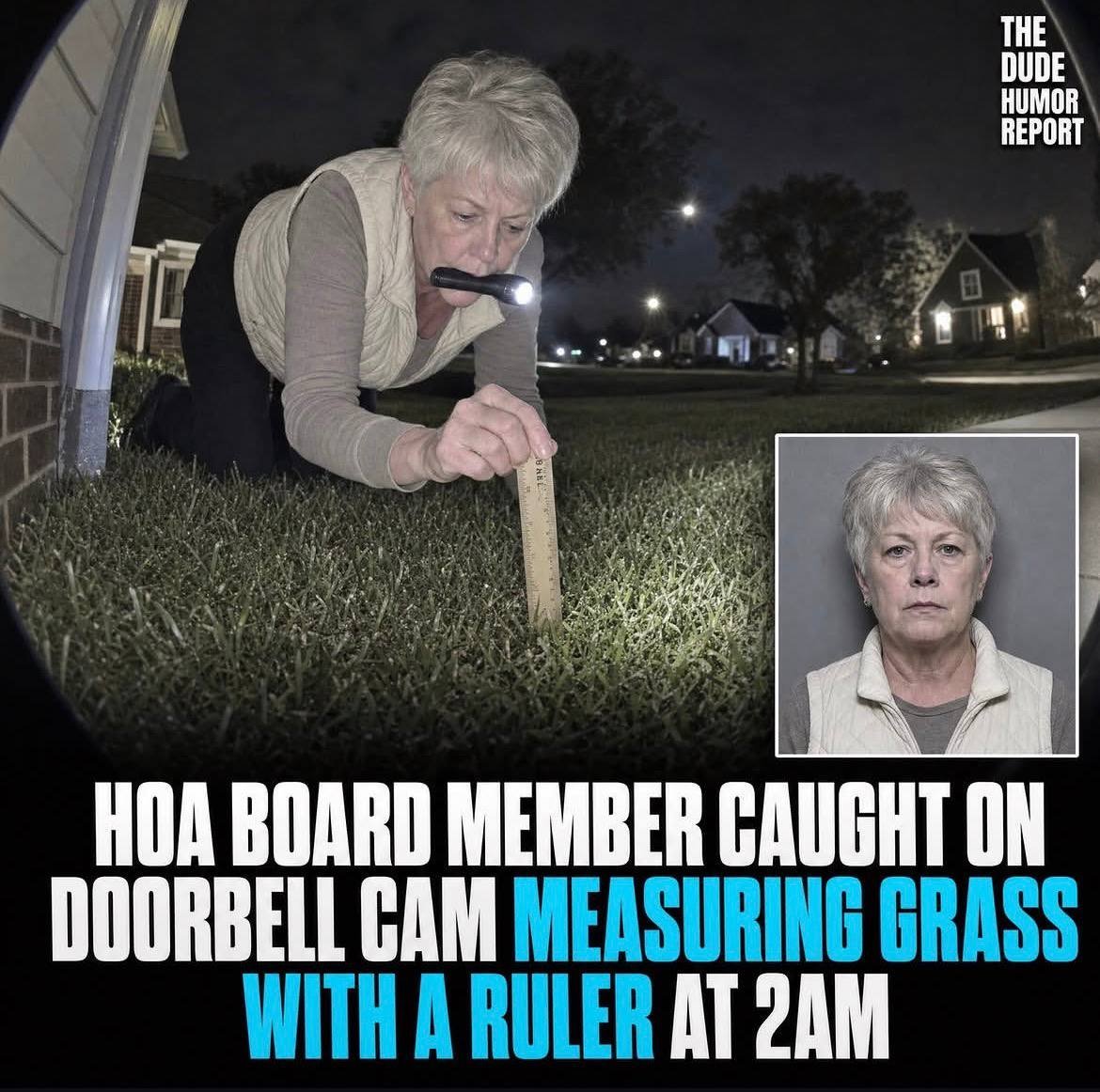
The photo is everywhere this week: a woman on her hands and knees in a suburban yard at 2 in the morning, flashlight clenched in her teeth, holding a wooden ruler up against blades of grass — caught on a doorbell camera. The inset mugshot-style portrait seals the joke. The caption: "HOA BOARD MEMBER CAUGHT ON DOORBELL CAM MEASURING GRASS WITH A RULER AT 2AM."
Let's be clear: it's satire, from a humor page. Nobody's grandmother is actually out there with a ruler at 2 AM.
But it went viral for a reason. Every homeowner who's ever dealt with an HOA board saw that photo and thought: yeah, that tracks. Because while the ruler is a joke, the dynamic behind it — a board with too much time, too much power, and a personal grudge — is something thousands of South Carolina homeowners live with.
If your HOA has stopped maintaining the community and started policing your life, this post is for you.
Satire — But Every Homeowner Gets the Joke
HOAs were supposed to protect property values: keep the common areas up, enforce reasonable standards, everybody benefits. And plenty of them do exactly that.
But anyone who's lived under a bad board knows the other version. The violation letters about your trash can being visible for twenty minutes. The fine for a fence stain color that's one shade off. The architectural review that approves your neighbor's identical project and denies yours. The board president who drives the neighborhood like it's a patrol route.
The grass-measuring meme lands because it exaggerates something real: enforcement that's not about the community anymore. It's about control.
When HOA Enforcement Becomes Harassment
There's a line between enforcing the rules and harassing homeowners, and boards cross it more often than you'd think. Watch for the pattern:
- Violation letters that never stop. One notice is enforcement. A letter every week about increasingly trivial things is a campaign.
- Moving the goalposts. The rule gets reinterpreted every time you comply. You fix what they cited, and suddenly there's a new violation.
- Surveillance-style monitoring. Board members photographing your property, showing up unannounced, questioning your contractors or guests.
- Fines stacked faster than you can respond. New fines arriving before you've had a chance to address the old ones.
- It's personal and everybody knows it. The enforcement started right after you complained about the board, ran against a board member, or questioned the budget.
One or two of these might just be an overzealous board. All of them together is a pattern — and patterns are what cases are built on.
Selective Enforcement: The Rule That Only Applies to You
The single most powerful defense in HOA disputes is selective enforcement. The principle is simple: a board can't punish you for something it lets everyone else do.
The board fines you for grass half an inch too tall while three other lawns on the street look the same. It denies your fence and approves your neighbor's. It enforces the parking rule against you and ignores the board president's own RV.
To use this defense you need evidence, not just a feeling:
- Photograph the other violations the board is ignoring — same rule, same neighborhood, no enforcement.
- Save every letter, email, and fine notice with dates.
- Note who sits on the board and whether anyone enforcing against you has a conflict or grudge.
- Request the HOA's violation and fine records. If the records show you're the only one being cited, that's your case.
Boards hate this defense because it's hard to argue with their own records.
HOA Fines in South Carolina: What the Board Must Do First
Here's what surprises most homeowners: the board usually can't just fine you out of nowhere. Your CC&Rs and bylaws — the governing documents — almost always require the board to give you notice of the alleged violation and an opportunity to be heard before fines stick.
That means:
- Read your governing documents. The answer to "can they do this?" is almost always in the CC&Rs. Get a copy if you don't have one — you're entitled to it.
- Demand the hearing. If the documents provide for one, use it. Show up with photos, dates, and your evidence of selective enforcement. Many fines die at the hearing stage because the board can't justify them on the record.
- Check the math. Fines must be authorized by the documents and applied the way the documents say. Boards that invent fine amounts or skip required steps hand you a defense.
- Don't ignore it and hope it goes away. Unpaid fines can become liens, and liens can become foreclosure actions. The time to fight a fine is when it's issued, not after it becomes a lien.
Every HOA's documents are different, which is exactly why generic internet advice only goes so far — and why having an HOA attorney read your specific CC&Rs matters.
Your Defenses When the HOA Comes After You
Beyond selective enforcement and procedural failures, homeowners have more tools than boards want them to know about:
- The board exceeded its authority. Boards can only do what the governing documents authorize. If the CC&Rs don't give the board power to do what it's doing, it's acting outside its authority.
- The rule itself is unreasonable or was never properly adopted. Rules have to be adopted the way the documents require. A "rule" the president announced at a meeting with no vote may not be a rule at all.
- Waiver. If the board knew about a violation for years and did nothing, it may have waived the right to enforce now.
- Retaliation. If the enforcement started after you exercised a right — questioning finances, requesting records, running for the board — that timing is evidence.
- The developer still controls the board. In newer communities, the developer often controls the HOA while still selling lots — and developer-controlled boards have their own conflicts, especially around condo construction defects they'd rather not pursue.
The right defense depends on your documents, your board's records, and the timeline. That's a case-by-case analysis, not a form letter.
How to Fight Your HOA and Win
If you're in a dispute with your HOA right now, do these things this week:
- Get your governing documents — CC&Rs, bylaws, rules and regulations, architectural guidelines. Read the enforcement and fine provisions.
- Document everything. Every letter, every fine, every photo of your property and the neighbors' properties. Dates on everything.
- Communicate in writing. Stop having phone arguments with board members. Email creates a record; phone calls don't.
- Request records. You're generally entitled to see the HOA's financial and enforcement records. Ask for them in writing.
- Use the hearing process if your documents provide one — and bring your evidence.
- Talk to a lawyer before it becomes a lien. Once fines turn into a lien or a lawsuit, your options narrow and the cost goes up. Early is cheaper than late.
And one thing not to do: don't stop paying assessments to "punish" the board. Withholding dues gives the HOA a clean claim against you and muddies every defense you have. Fight the enforcement action, keep the assessments current.
Talk to a South Carolina HOA Dispute Lawyer
Nobody's actually measuring your grass with a ruler at 2 AM. But if your board is targeting you with endless violations, stacking fines, enforcing rules against you that it ignores for everyone else, or retaliating because you spoke up — that's not a joke, and you don't have to take it.
Call Traywick Law at (843) 343-5092. I'll read your HOA's governing documents, look at the board's enforcement pattern, and tell you straight whether you have leverage — and how to use it. The consultation is free, and the sooner you push back, the more options you have.