Credit Card Charged Off in South Carolina? What Happens Next and How a Lawyer Can Help
A charge-off does not erase your credit card debt. It means the creditor wrote the account off as a loss — usually after 180 days of non-payment — and what happens next is often worse: collection calls, a debt buyer, or a lawsuit. Here is what a charge-off means in South Carolina, what debt collectors can and cannot do, and how a lawyer helps you deal with creditors.
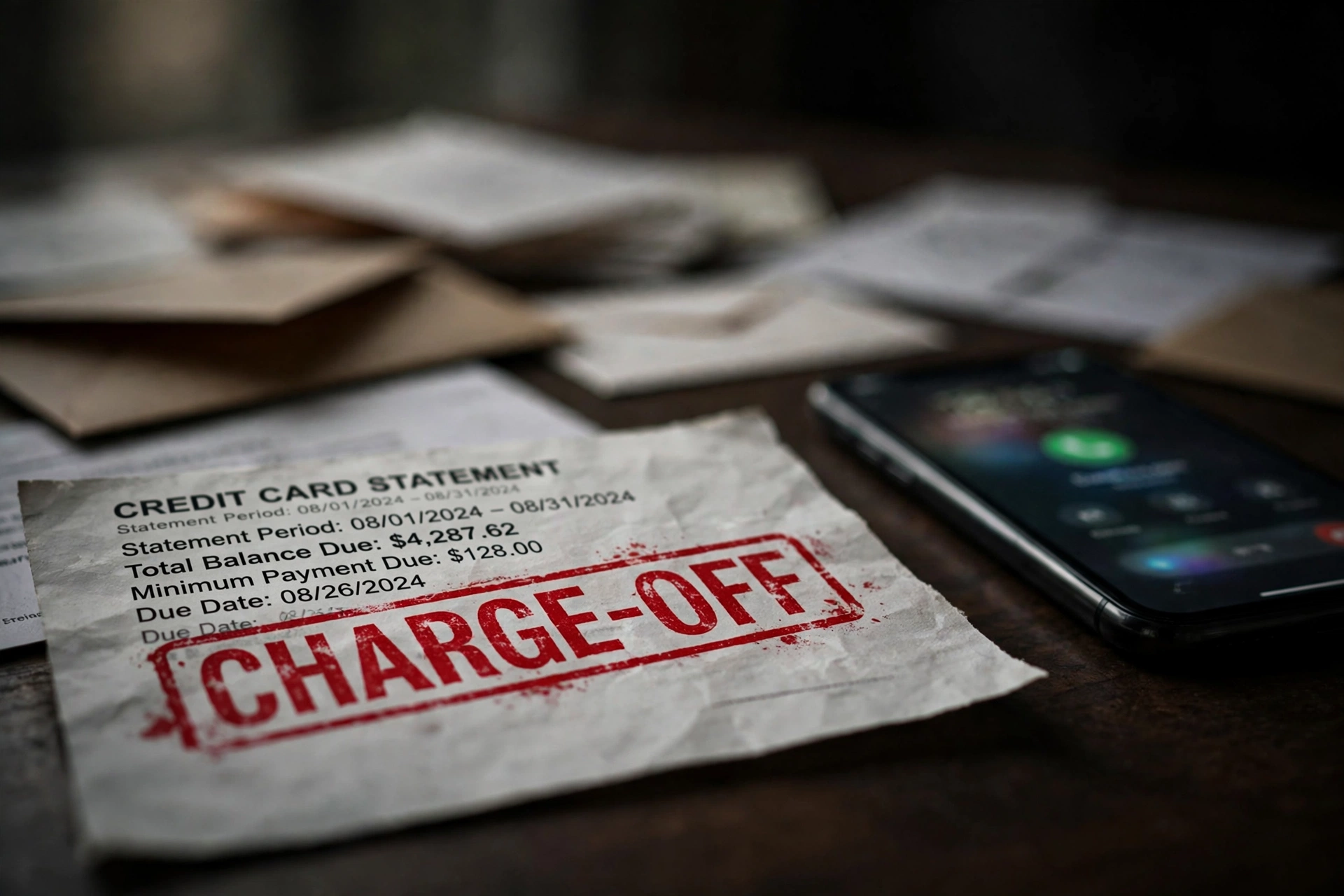
You missed payments. Then more. Now the statement says "charged off," and you want to know what that means — whether you still owe the money, who comes after you next, and what you can do about it.
A charge-off sounds final. It is not. It is the creditor's accounting decision, and it usually marks the moment your debt problem gets handed to someone more aggressive.
What Does "Charge-Off" Mean on a Credit Card?
Federal banking regulators require credit card issuers to charge off an account after 180 days without payment. At that point the issuer removes the balance from its books as an active receivable and typically claims a tax deduction for the loss.
That is all a charge-off is: a bookkeeping entry and a tax move. It does not cancel your contract. It does not release you from the balance. The amount you owe survives the charge-off in full.
The charge-off also hits your credit report as a serious derogatory mark. It stays for seven years from the date of your first missed payment — not from the charge-off date. Both the original creditor's charge-off entry and any later collection entry can appear, compounding the damage.
Do You Still Owe the Debt After a Charge-Off?
Yes. Every dollar. A charge-off changes who may come after you and how — not whether you owe.
After charging off the account, the creditor has three options. It can keep collecting through its own collections department. It can assign the account to an outside collection agency. Or it can sell the debt to a debt buyer, usually for pennies on the dollar, and the buyer then owns the full balance and the right to collect it.
Most charged-off credit card debt ends up with a debt buyer. That buyer paid almost nothing for your account and profits by collecting as much of the face amount as possible. Expect pressure.
What Happens After the Charge-Off: Who Comes After You
The sequence is predictable. First, the original creditor's internal collectors call and write. They are most willing to negotiate during this window because they still own the debt.
After the charge-off, the account typically moves to a third-party collector or a debt buyer. The tone changes. You get more calls, more letters, and eventually a summons if the balance justifies a lawsuit. Debt buyers sue routinely — often on accounts where their paperwork is thin.
One warning matters more than any other: do not pay a collector, promise to pay, or acknowledge the debt until you know the account's age and legal status. In South Carolina, a payment or a written promise to pay can restart the three-year clock to sue you. Collectors know this. Many push for a small "good faith" payment for exactly that reason.
Can a Debt Collector Sue You After a Charge-Off in South Carolina?
Yes — if the debt is still within the statute of limitations. A charge-off gives the collector no new rights, but it takes none away either. If the creditor could have sued you the day before the charge-off, the debt buyer can sue you the day after.
Collectors sue when the math works: balances large enough to justify legal costs, a debtor with reachable assets or income, and a debt young enough to survive a limitations defense. If you are sued by a debt buyer, answer the summons by the deadline printed on it. Never ignore a collection lawsuit. In South Carolina, failing to respond hands the collector a default judgment — and a judgment opens the door to bank account levies and property liens.
South Carolina's 3-Year Deadline to Sue for Credit Card Debt
South Carolina gives creditors three years to sue on credit card debt. S.C. Code § 15-3-530. The clock starts on the date of your last payment or the date you default — not when the account was opened, and not when it was charged off.
Three years is short. It is one of the shortest limitations periods in the country, and it is the single most powerful defense in a South Carolina collection case. If the collector files even one day late, the debt is time-barred and you can get the case dismissed.
But the defense is not automatic. You must raise it. A court can still enter judgment against you on a time-barred debt if you do not show up and assert the defense yourself. And collectors can still contact you about time-barred debt — they just cannot win a lawsuit on it, and threatening to sue on a debt they know is time-barred violates federal law.
Your Rights Under the Fair Debt Collection Practices Act
The Fair Debt Collection Practices Act, 15 U.S.C. § 1692, is the federal law that controls what third-party debt collectors can do. It does not cover the original creditor collecting its own debt — but in South Carolina, the state Department of Consumer Affairs treats original creditors, debt buyers, collection agencies, and collection attorneys as debt collectors under state consumer protection guidance. Between the two, collectors have very little room to maneuver.
Under the FDCPA, a collector must send you a written validation notice within five days of first contact. The notice must state the amount owed, the creditor's name, and your right to dispute the debt within 30 days. If you dispute in writing within those 30 days, the collector must stop and verify the debt before continuing. Send a debt validation letter before you pay anything.
The law also bans specific conduct outright:
- Calls before 8 a.m. or after 9 p.m.
- Contact at work after you tell them your employer does not allow it
- Discussing your debt with family, neighbors, or coworkers
- Harassment, threats, profanity, or repeated calls meant to annoy
- False or misleading statements — including threatening to sue when they cannot, or threatening wage garnishment in South Carolina where the law bars it for consumer debt
- Collecting amounts you do not owe or that the contract does not allow
You can also cut off contact. A written request that the collector stop communicating forces them to stop, with narrow exceptions such as notifying you of a lawsuit. And if a collector violates the FDCPA, you can sue: statutory damages up to $1,000 per action, plus actual damages and attorney's fees. The one-year deadline to file runs from the violation.
What Debt Collectors Cannot Do in South Carolina
South Carolina adds protections the federal law does not. The most important: wage garnishment is prohibited for consumer debt. S.C. Code § 37-5-104 bars creditors from garnishing your earnings for a consumer credit sale, consumer loan, or similar consumer obligation. The only exceptions are debts owed to the government, court-ordered support, and certain out-of-state garnishment orders.
That does not mean a judgment is harmless. A collector with a judgment can still levy your bank account, place liens on property, and seize non-exempt assets. South Carolina's property exemptions protect some of what you own — but you must claim them.
The practical takeaway: when a collector threatens to garnish your wages over a South Carolina credit card debt, the threat is usually empty — and making it may itself violate the FDCPA's ban on false threats.
How a Lawyer Helps You Deal With Creditors and Debt Collectors
You can face collectors alone. Most people who do either pay debts they could have defeated or ignore lawsuits they could have won. A lawyer changes the leverage in specific ways.
Verify the debt before you pay a dollar. Debt buyers purchase spreadsheets, not file cabinets. They often cannot prove they own your account or that the balance is right. A lawyer demands validation and the full chain of assignment — and when the collector cannot produce it, the case collapses.
Check the statute of limitations. If your last payment was more than three years ago, the collector's lawsuit may be dead on arrival. A lawyer dates the debt precisely and raises the time-barred defense.
Stop the harassment. A written cease-communication demand ends the calls. If the collector already broke the law — illegal threats, false statements, contact after a cease request — a lawyer can sue under the FDCPA, where the collector pays your attorney's fees if you win.
Negotiate from strength. Collectors settle. A lump-sum payment for less than the balance, a structured payment plan, or a hardship arrangement with the original creditor are all standard outcomes. A lawyer can negotiate a reduced payoff with the collector knowing you have defenses. Get every settlement in writing before you pay. Note that forgiven debt over $600 can trigger a 1099-C and taxable income; a lawyer factors that into the deal.
Defend the lawsuit. If you are sued, a lawyer answers on time, raises every defense — limitations, standing, faulty documentation — and forces the collector to prove its case. Debt buyers dismiss or lose a large share of cases when the debtor shows up with counsel.
Whether you are current and falling behind, already in collections, or holding a summons, the earlier a lawyer gets involved, the more options you keep.
Talk to a South Carolina Credit Card Debt Lawyer Before You Pay a Collector
Do not pay a collector, agree to a payment plan, or acknowledge an old debt until you know exactly where you stand — the balance, the owner, and the age of the account. One wrong payment can restart the clock and cost you your best defense.
Contact Traywick Law Offices for a free consultation. We deal with creditors and debt collectors every day: validation, negotiation, FDCPA claims, and lawsuit defense across South Carolina.