How to Stop Robocalls and Marketing Texts: Your Rights Under the TCPA
Your phone buzzes all day with robocalls and marketing texts you never asked for. Federal law — the Telephone Consumer Protection Act — gives you the right to make them stop, and it pays $500 for every call or text that breaks the rules. Here's the violation checklist, how to opt out so it sticks, how to get on the Do Not Call Registry, and what to do when a company won't stop.
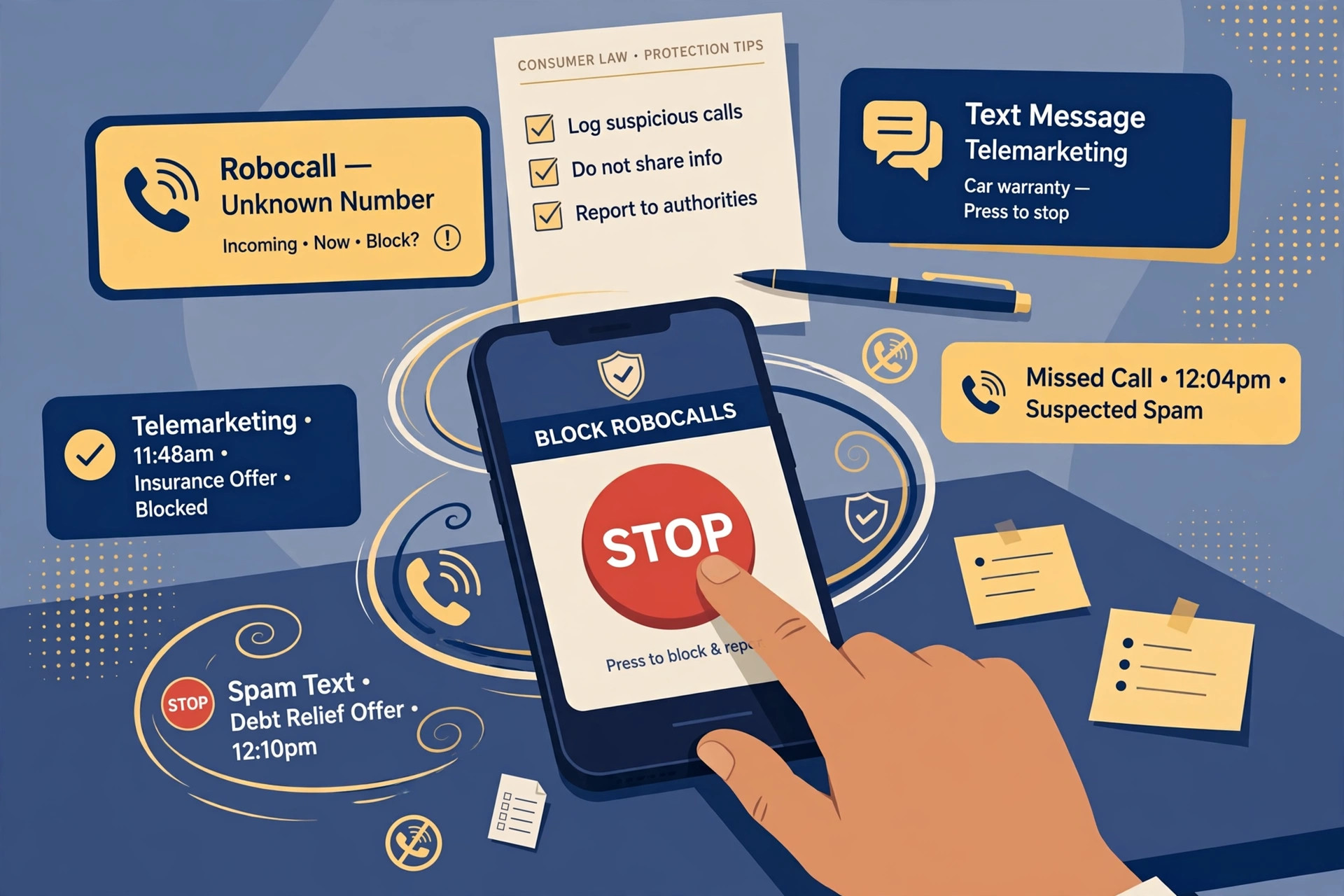
Your phone rings during dinner. It's a recording. A text lands at 7 a.m. pitching something you never asked about. You press STOP, and the texts keep coming anyway.
Congress wrote a law for exactly this. The Telephone Consumer Protection Act — the TCPA — restricts robocalls, autodialed calls, prerecorded messages, and marketing texts, and it lets you sue when a company breaks the rules. Each illegal call or text can be worth $500, and up to $1,500 if the violation was willful.
This guide covers what the TCPA is, what counts as a violation, how to opt out in a way that creates a paper trail, how to get on the Do Not Call Registry (and what it won't stop), and what your options are when a company ignores you. If the calls are coming from a debt collector, a different law with its own opt-out rules may also apply — more on that below.
What Is the Telephone Consumer Protection Act (TCPA)?
The TCPA is a federal law enacted in 1991, codified at 47 U.S.C. § 227. It restricts the use of automatic telephone dialing systems, artificial or prerecorded voices, and unsolicited fax advertising. The Federal Communications Commission (FCC) writes the rules that implement it, at 47 C.F.R. § 64.1200.
Two things about the TCPA surprise people:
Text messages are "calls." The statute was written before texting existed, but courts treat a text message as a call under the TCPA — the Ninth Circuit held so in Satterfield v. Simon & Schuster, 569 F.3d 946 (9th Cir. 2009), and that reading is now the national consensus. Every rule below that mentions calls applies to marketing texts too.
You can sue yourself. The FCC enforces the TCPA, but the real engine is the private lawsuit. Section 227(b)(3) gives any person a right to sue for violations — no regulator has to act first.
TCPA Violation #1: Robocalls and Robotexts to Your Cell Phone Without Consent
Section 227(b)(1)(A) makes it unlawful to call a cell phone using an automatic telephone dialing system or an artificial or prerecorded voice — unless the call is an emergency or the called party gave prior express consent.
That single sentence is the heart of the TCPA. If a business autodials your cell phone, plays you a recording, or fires off marketing texts from an automated platform, and you never agreed to be contacted that way, the call or text is illegal the moment it happens. It does not matter that the message was short, polite, or about something you once bought. Without consent, there is no legal basis for the contact.
TCPA Violation #2: Telemarketing Without Your Prior Written Consent
Consent comes in tiers, and telemarketing sits in the strictest one.
Under the FCC's rules, a company needs your prior express written consent before it can send autodialed or prerecorded telemarketing calls or texts to your cell phone. Written consent means an actual agreement, in writing (an e-signature or a checked box can count), that clearly authorizes marketing calls or texts to your number. Handing a cashier your phone number for a receipt is not written consent to receive sales texts.
For purely informational messages — an appointment reminder, a fraud alert, a delivery notice — the standard drops to prior express consent, which can be as simple as giving the company your number in the first place. But the moment the message's purpose turns to selling, the written-consent rule applies.
Watch out for the mixed message. A text that sounds neutral — "Can I text you?" — can still be telemarketing if its purpose is marketing. A federal court applied that purpose-over-wording test to a car dealership's texts this fall; we covered that ruling in detail in our post on when car dealer texts violate the TCPA.
TCPA Violation #3: Calls and Texts After You Said Stop
Consent is not forever. Under the FCC's long-standing rule, you may revoke consent to robocalls and robotexts at any time, in any reasonable manner — even if you gave permission before.
Replying STOP to a text is the clearest revocation there is. Saying "take me off your list, do not call me again" on a call works too. The caller gets one courtesy: the FCC allows a single confirmation text acknowledging your opt-out. Everything after that arrives without consent, and each message is its own violation.
This is where companies get in the deepest trouble. A consumer who never opted in might be owed $500 per text. A consumer who opted in, replied STOP, and kept getting texts has a willfulness argument — and that is where damages triple.
If the sender is a debt collector, you have a second opt-out weapon: the FDCPA lets you cut off collector contact in writing, and it works even where the TCPA analysis is murkier. We walked through that process in our guide to opting out of debt collector contact.
TCPA Violation #4: Telemarketing Calls to Numbers on the Do Not Call Registry
Section 227(c) and the FCC's rules prohibit telephone solicitations to residential numbers listed on the National Do Not Call Registry. If your number has been registered for at least 31 days and a telemarketer calls anyway, that call violates the rules — and if you receive more than one unlawful call from the same company within a 12-month period, you can sue over it under § 227(c)(5), for the same $500-to-$1,500 per call.
The Registry is not a complete shield — it has real limits, covered below — but for legitimate telemarketers it draws a bright line, and crossing it is expensive.
TCPA Violation #5: Prerecorded Sales Calls to Your Home Phone
Section 227(b)(1)(B) separately bans initiating a call to a residential line using an artificial or prerecorded voice to deliver a message, without the prior express consent of the called party. For telemarketing recordings, the FCC requires that consent to be in writing. So the recorded sales pitch that lands on your home phone — "This is an important message about your account" followed by an offer — is a violation all by itself, cell phone or not.
TCPA Violation #6: Unsolicited Fax Advertisements
The TCPA also bans using a fax machine, computer, or other device to send an unsolicited advertisement to a fax machine, under § 227(b)(1)(C), subject to an established-business-relationship exception that comes with its own opt-out notice requirements. Junk faxes are less common than they were in 1991, but they still happen — and they are still worth $500 apiece.
What Is an Autodialer After Facebook v. Duguid?
Defendants in TCPA cases often argue about the equipment. In Facebook, Inc. v. Duguid, 592 U.S. 395 (2021), the Supreme Court narrowed the definition of an "automatic telephone dialing system": the equipment must have the capacity to store or produce telephone numbers using a random or sequential number generator, and to dial them. A platform that merely dials from a fixed customer list may fall outside that definition.
Do not let a company wave Duguid at you as a complete defense. The prerecorded-voice rules do not depend on the dialer at all. The written-consent rule for telemarketing is enforced separately. And the revocation rule applies no matter what machine did the dialing. In most real cases, the fight is about consent — did the company have it, and did you take it back — not about the hardware.
How to Opt Out of Robocalls and Marketing Texts, Step by Step
Opting out is free, and doing it the right way creates the evidence you would need later. Work through these steps:
- Reply STOP to marketing texts. STOP, END, CANCEL, UNSUBSCRIBE, and QUIT are the standard opt-out keywords. Then screenshot the confirmation message and save it. That screenshot is proof of the date you revoked consent.
- On calls, say it plainly. "I am revoking my consent. Do not call this number again." Write down the date, the time, the number that called, and the company name, if you got one.
- Put repeat offenders in writing. If a company keeps calling after a verbal opt-out, send a short written revocation by email or mail: your name, your number, and the sentence "I revoke any consent to call or text this number, effective immediately." Keep a copy.
- Ask for the internal do-not-call list. Telemarketers must maintain company-specific do-not-call lists under federal rules. Asking to be placed on the company's own list creates a separate duty to stop, on top of the national Registry.
- Keep a log, and keep everything. Save screenshots, voicemails, and call history. Do not delete the texts. A simple log — date, time, number, what was said — turns "they won't stop calling me" into a countable list of violations.
How to Get on the Do Not Call Registry — and What It Won't Stop
Registration is free and takes two minutes:
- Online: go to donotcall.gov and enter up to three numbers and an email address. You will get a confirmation email for each number — click the link within 72 hours to finish.
- By phone: call 1-888-382-1222 (TTY: 1-866-290-4236) from the phone you want to register. You must call from that number.
Three facts the FTC is clear about:
Registration never expires. Since 2008, numbers stay on the Registry permanently. The FTC removes a number only if it is disconnected and reassigned, or you ask to take it off. Anyone emailing you that your registration is "about to expire" is running a scam. If you are not sure whether your number is registered, you can check at donotcall.gov or by calling 1-888-382-1222 from that number — and if calls keep coming more than 31 days after you registered, the FTC takes complaints on the same site.
Telemarketers get up to 31 days. Your number appears on the Registry the next day, but covered telemarketers have up to 31 days from registration to stop calling. Calls in that window are not violations.
The Registry has carve-outs. It does not stop calls from charities, political organizations, or telephone surveyors. Companies you have an existing business relationship with can keep calling unless you tell them to stop. Debt collectors are not covered by the Registry at all — though if a collector is harassing you, the Fair Debt Collection Practices Act gives you separate, powerful rights. And scammers simply ignore the Registry; it stops legitimate businesses, not criminals.
That is why the opt-out in the previous section matters so much. Your revocation right applies to a specific company even when the Registry doesn't — including companies you once did business with.
Can I Sue for Robocalls? What Each Violation Is Worth
Yes. Section 227(b)(3) lets you recover your actual monetary loss or $500 per violation, whichever is greater — and the court may increase that to $1,500 per violation if the defendant knowingly or willfully broke the law. There is no cap on the total: ten post-STOP texts are ten violations. Federal law generally gives you four years from the violation to file.
The math is why companies settle these cases. A marketing campaign that texted 200 people without written consent does not face one penalty — it faces 200.
What About Attorney's Fees Under the TCPA?
Honest answer: the TCPA itself does not shift attorney's fees. The $500-per-violation damages are the mechanism Congress chose, and they are what make these cases economically possible to bring.
But the caller on your phone may be reachable under a law that does pay fees:
- If the caller is a debt collector, the FDCPA requires a collector that loses to pay the consumer's costs and reasonable attorney's fee, under 15 U.S.C. § 1692k(a)(3). The same calls can support both claims.
- Unfair or deceptive calling practices can also support an individual claim under the South Carolina Unfair Trade Practices Act, which provides for attorney's fees and treble damages for willful violations, under S.C. Code § 39-5-140(a). Our consumer fraud page explains how SCUTPA works.
Which law fits your facts depends on who is calling and why — and whether you have leverage depends on your facts. That evaluation costs you nothing.
A Company Keeps Texting Me After I Said Stop — What Now?
If you have opted out, registered your number, and the calls and texts keep coming, here is the sequence:
- Do not delete anything. Screenshots, call logs, and voicemails are the case.
- Count the violations. Every post-revocation call or text, and every call to your registered number after the 31-day window, is a separate $500 item.
- Do not engage further. You do not need to argue with them. Silence plus records beats repeated opt-outs.
- Talk to a consumer lawyer. Bring your log and your screenshots. Traywick Law Offices represents South Carolina consumers against companies that won't stop — whether the caller is a telemarketer, a business you never dealt with, or a debt collector hiding behind "courtesy calls."
Call Traywick Law Offices at (843) 343-5092 or request a free consultation through our legal opinion intake page. One conversation tells you what your call log is worth.